Visuals
Blockchain
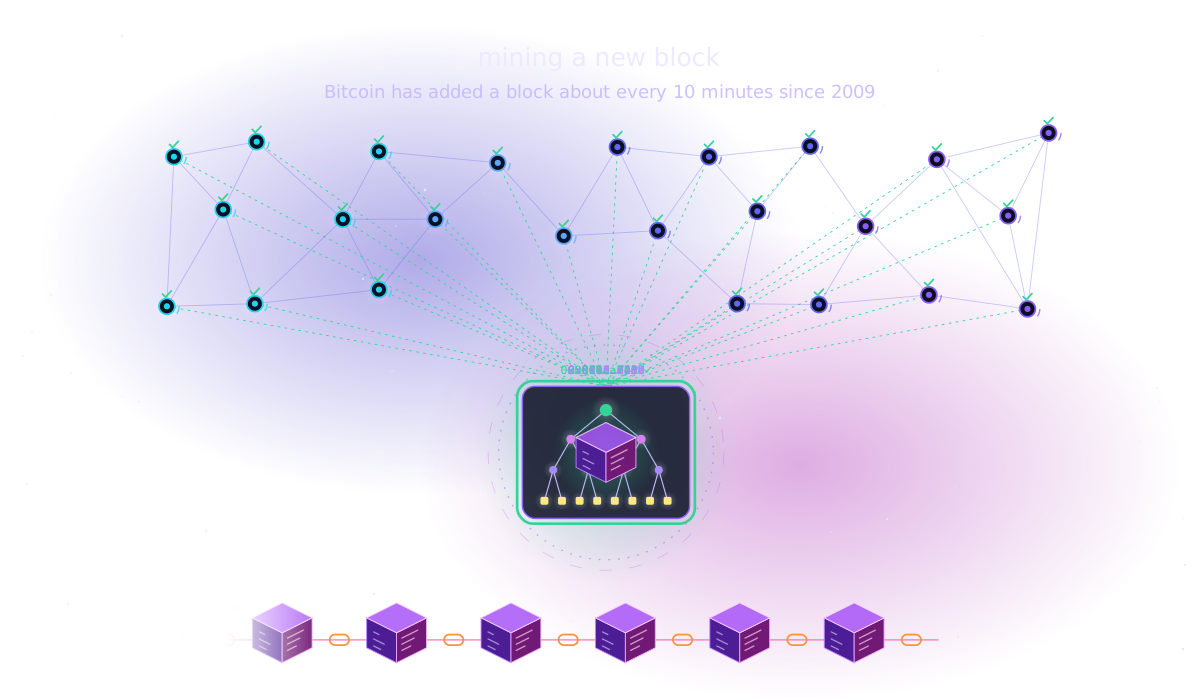
Peers gossip transactions into a Merkle tree, miners try nonces until the hash fits, and the new block joins the chain.
Diffusion
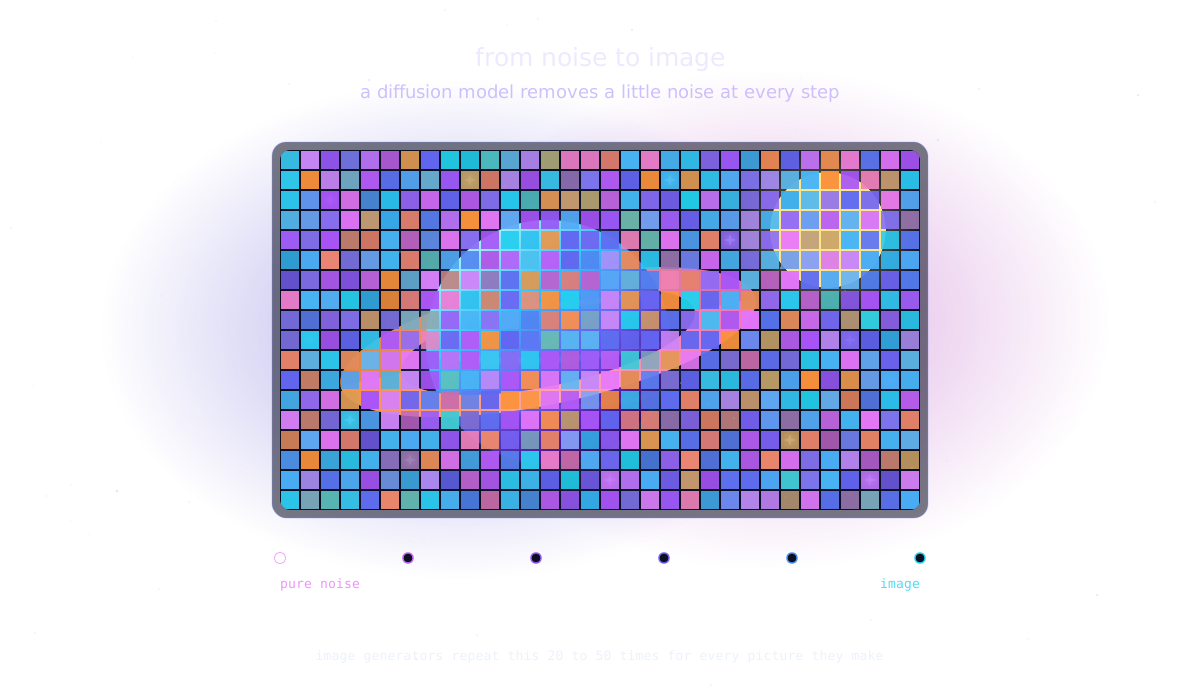
Starting from pure noise, every denoising step reveals a little more, from coarse blocks to a sharp image.
GPU
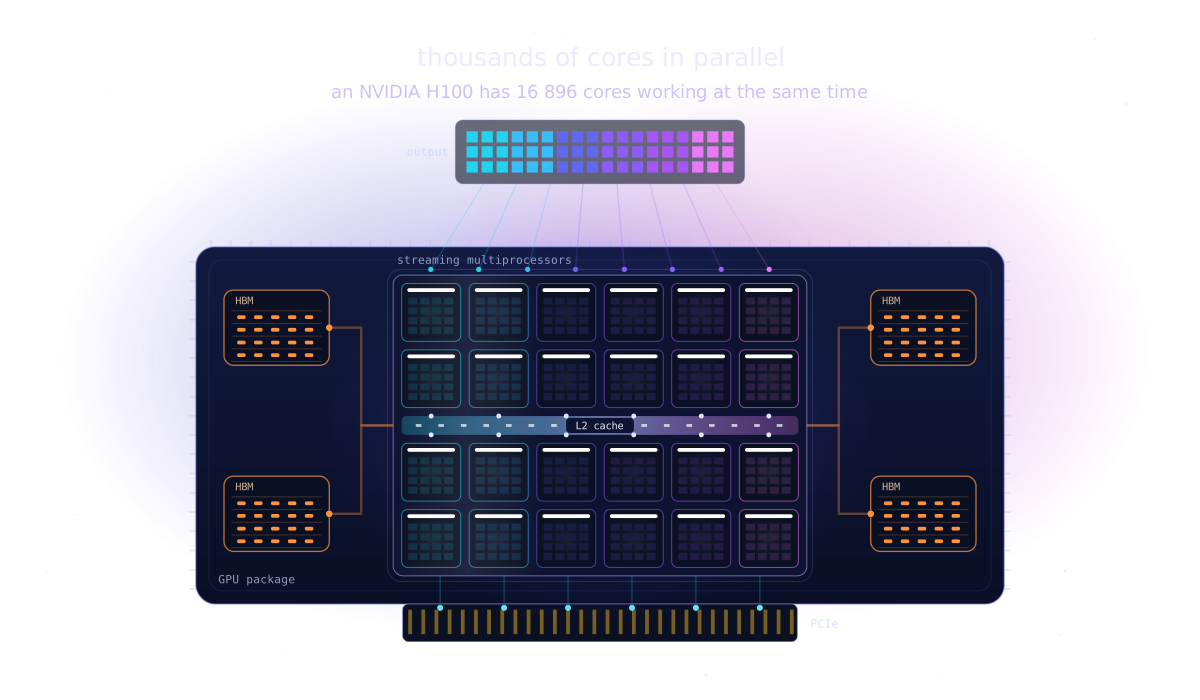
Data streams over PCIe and from HBM into thousands of cores working in parallel to fill the output matrix C = A × B.
Kubernetes
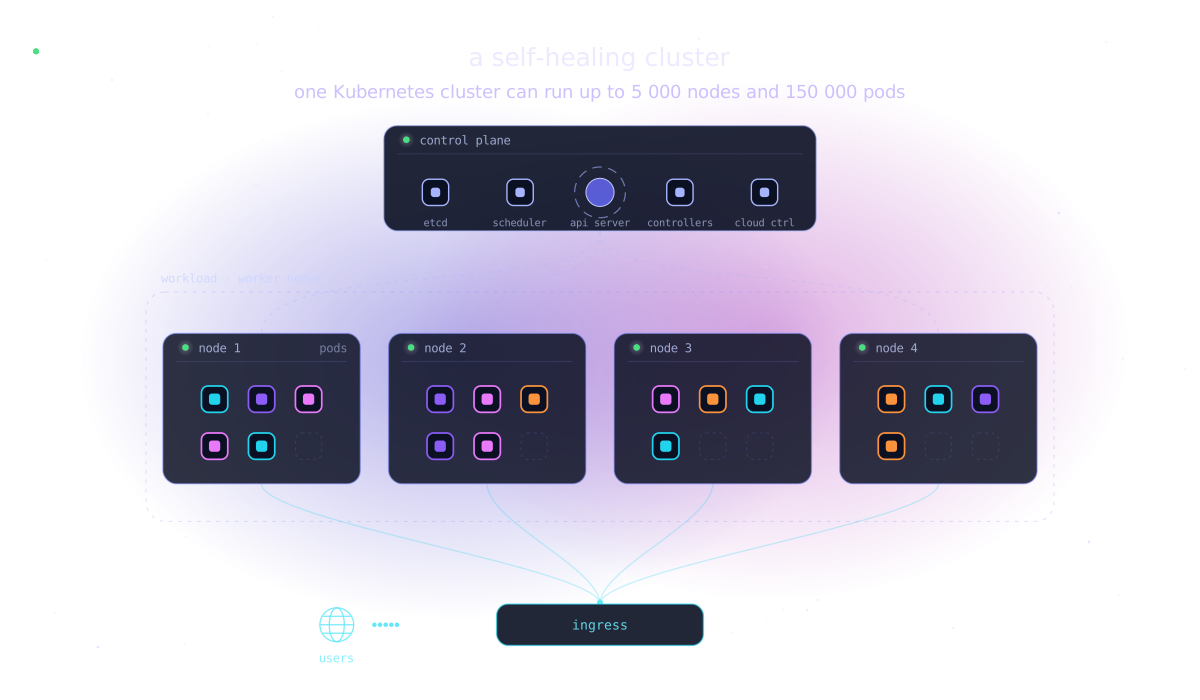
The control plane schedules pods onto nodes, heartbeats keep it informed and the ingress routes traffic to them.
LLM
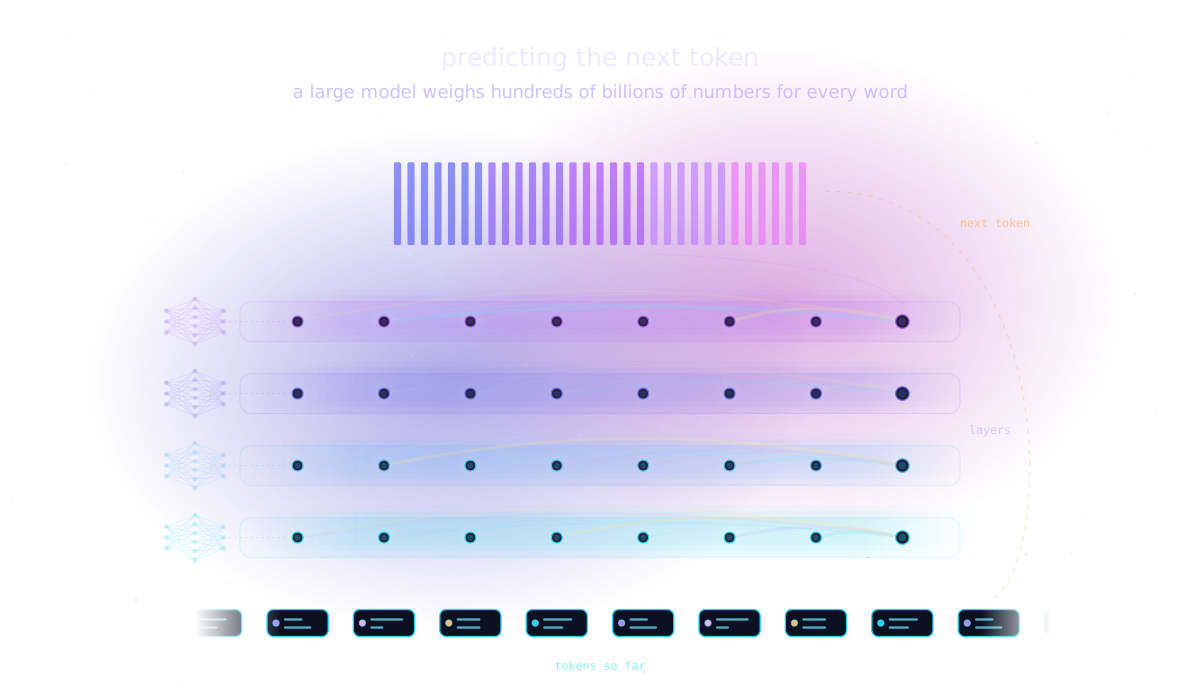
Each token flows through attention and feed-forward layers, the softmax picks the next one and it joins the sequence.
NeuralNetwork
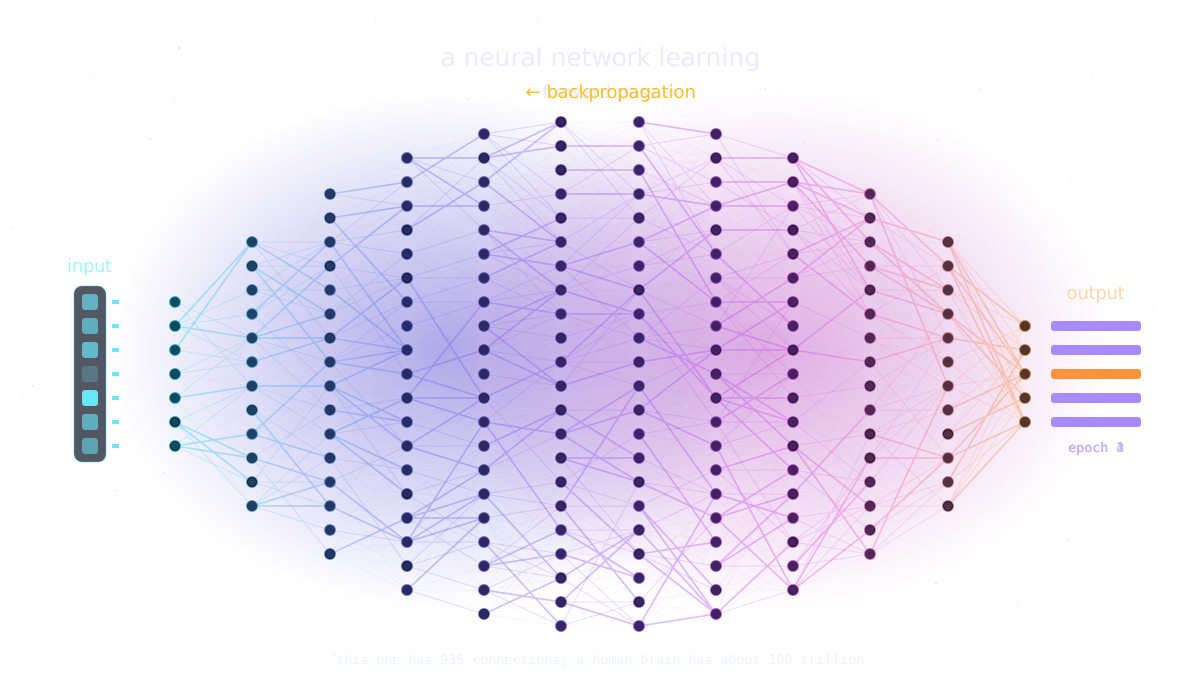
A forward pass makes a prediction, backpropagation sends the error back, and the right answer grows more confident every epoch.
Quantum
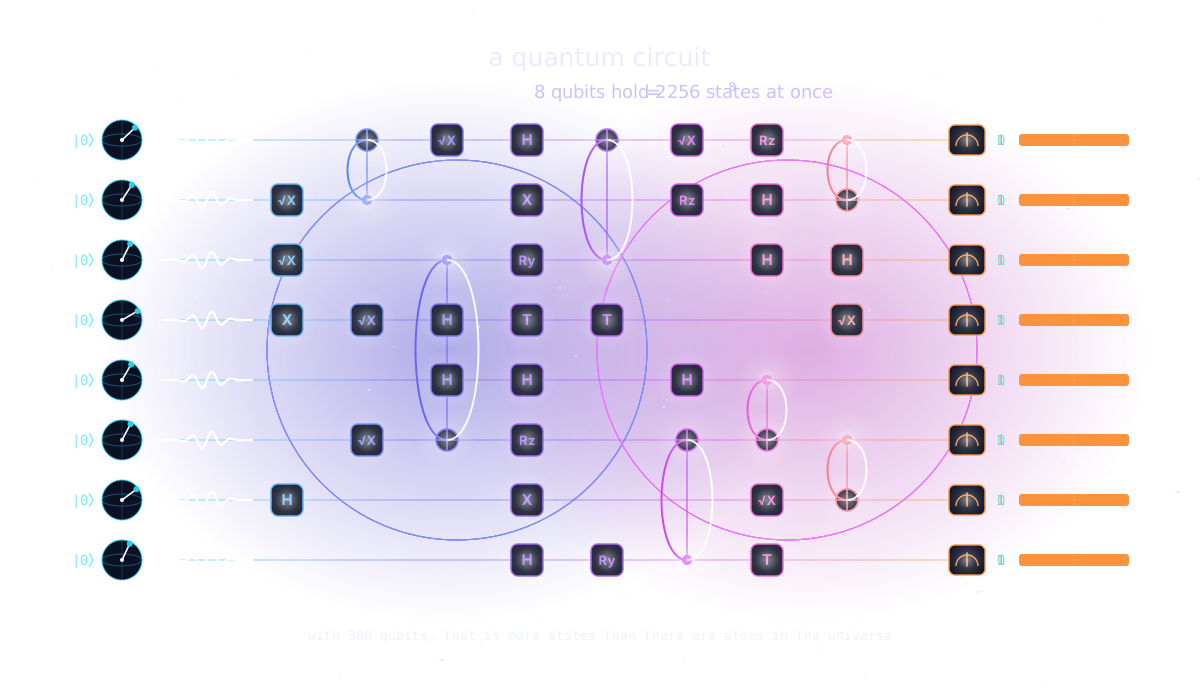
Qubits pass through gates and become entangled, then each measurement collapses them into bits that build up a histogram.
FlipFlop
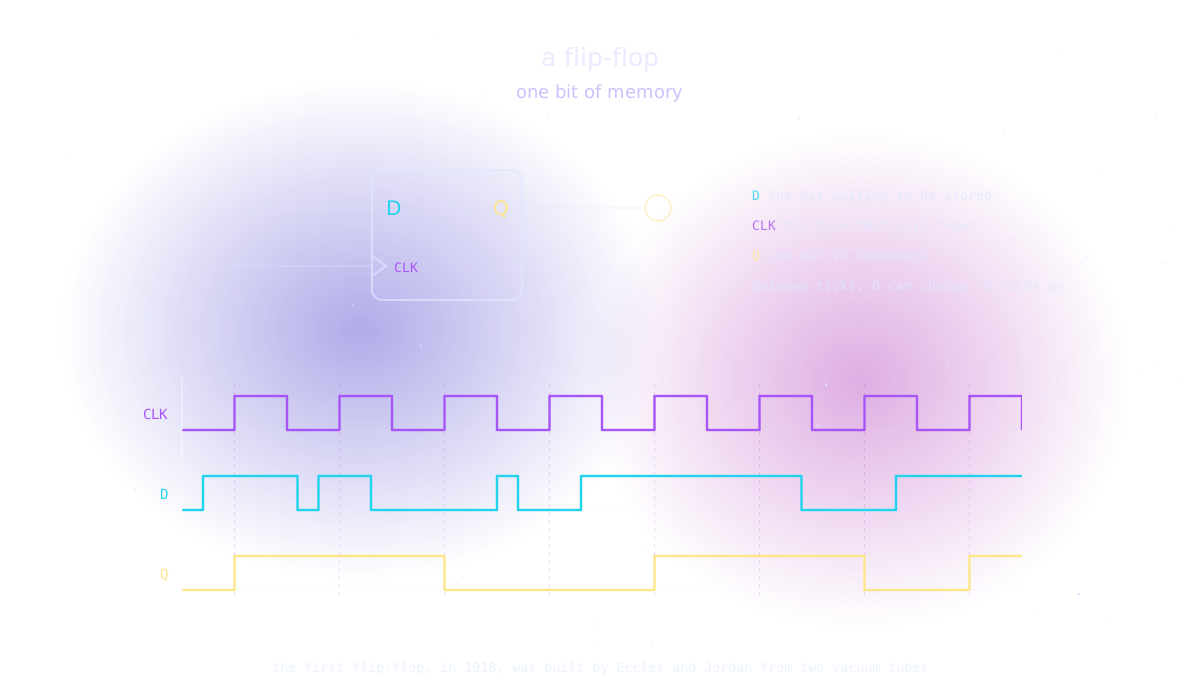
A flip-flop stores one bit. The input D can change whenever it likes, but only at the tick of the clock does the output Q copy it, and then Q holds that bit until the next tick. Billions of these remember the state inside every processor.
Karnaugh
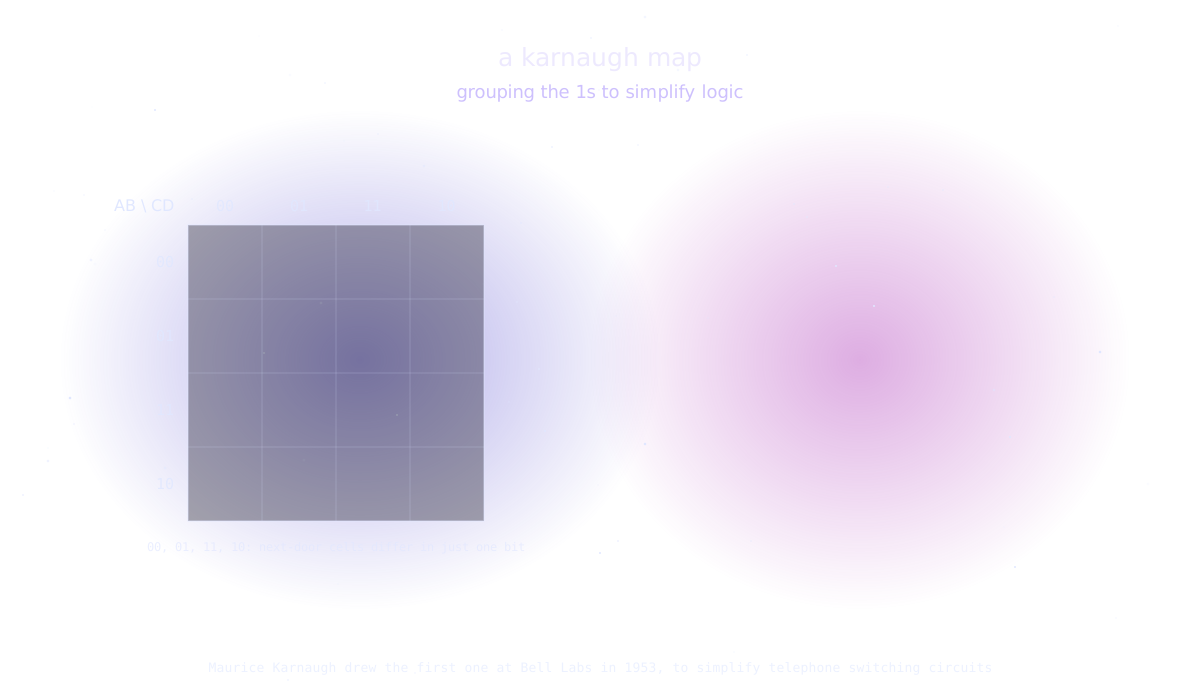
A Karnaugh map lays out every input of a logic function so that next-door cells differ in a single bit. Draw boxes of 1, 2, 4 or 8 ones, even round the edges, since the map wraps, and each box becomes one short term: here a function of 10 terms shrinks to 3, which means fewer gates on a chip.
LogicGates
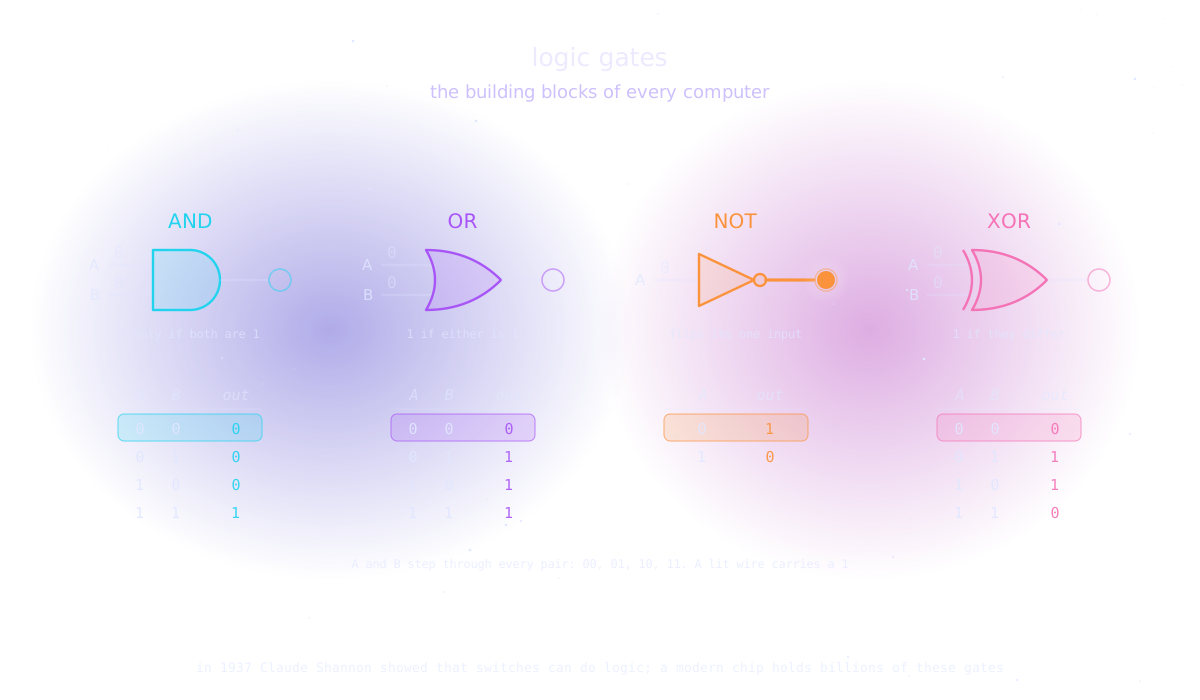
Every computer is built from tiny switches called logic gates. AND gives 1 only when both inputs are 1, OR when either is, NOT flips its input and XOR gives 1 when the two differ. Here the inputs step through every pair, and each gate's lamp and truth table follow.
Euler
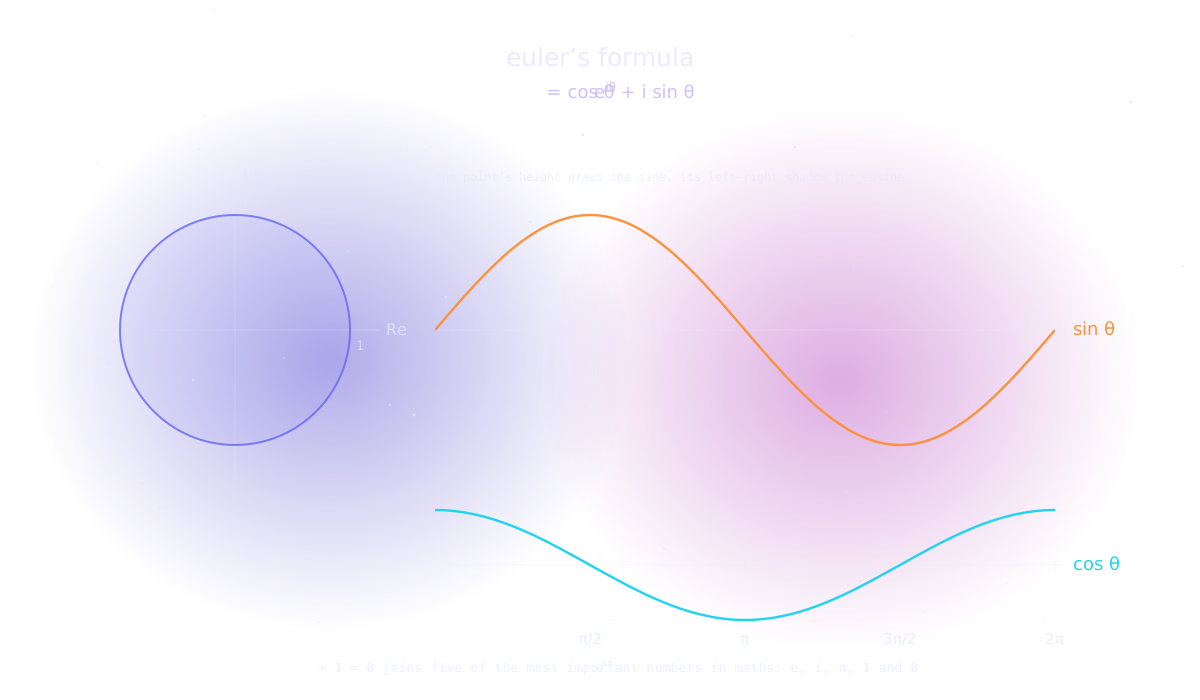
Euler's formula ties the exponential to circles: e to the power iθ is the point at angle θ on the unit circle, so its height traces the sine and its shadow the cosine, and half a turn lands on −1.
Hypercube
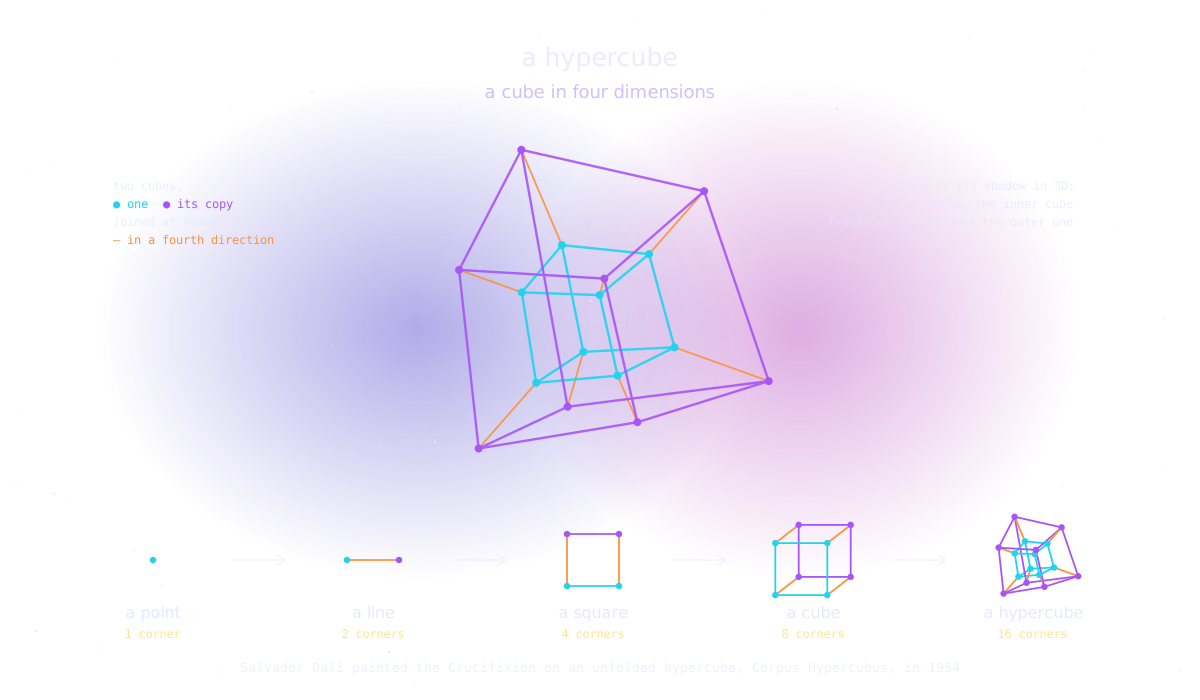
Take two copies of a shape and join their matching corners: a point becomes a line, a line a square, a square a cube, and a cube a hypercube, a cube in four dimensions with 16 corners. We can only see its shadow in 3D, and as it turns through the fourth direction the inner cube flows out and becomes the outer one.
Mandelbrot
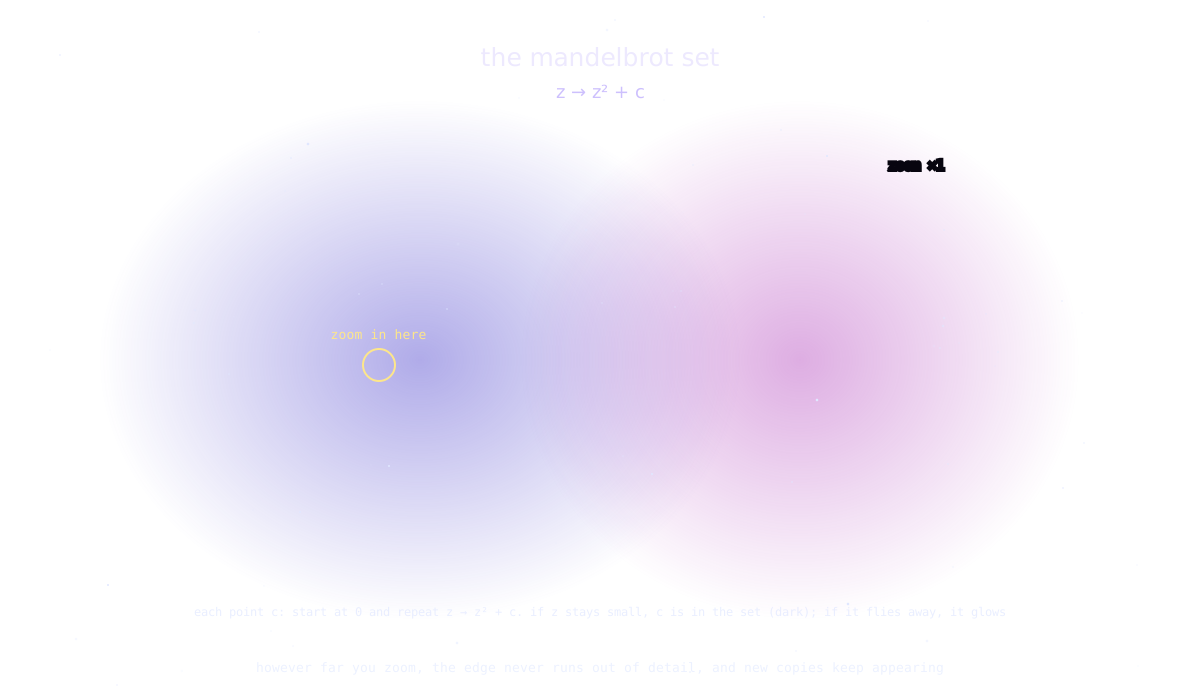
One simple rule, repeated for every point, draws this shape. Zoom into its edge and the detail never runs out: out on the thin needle to the left sits a tiny, perfect copy of the whole set.
Matrix
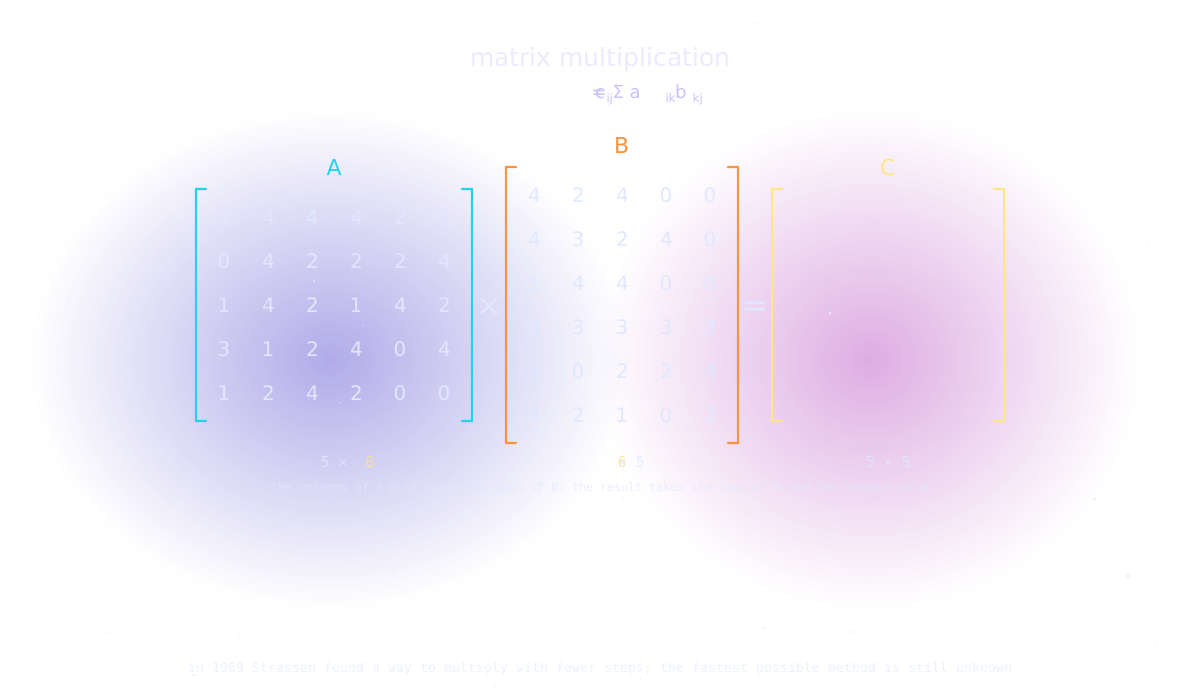
To multiply two matrices, every number of the result takes a row of the first and a column of the second, multiplies them pair by pair and adds it all up. That is why the columns of the first must match the rows of the second, and a 5×6 times a 6×5 gives a 5×5. Graphics cards do trillions of these every second, for games and for AI.
Phi
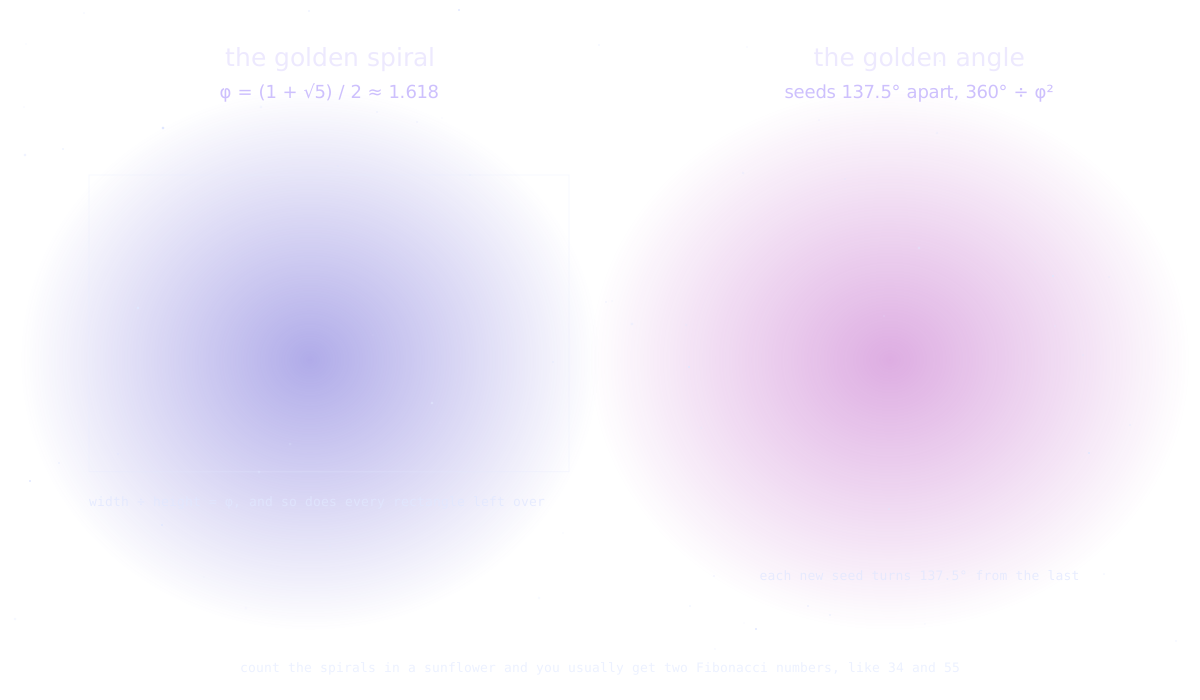
φ, about 1.618, is the ratio where a rectangle minus a square leaves a smaller copy of itself, which traces the golden spiral; turn each new seed by the matching golden angle, 137.5°, and you get the packing of a sunflower head.
Pi
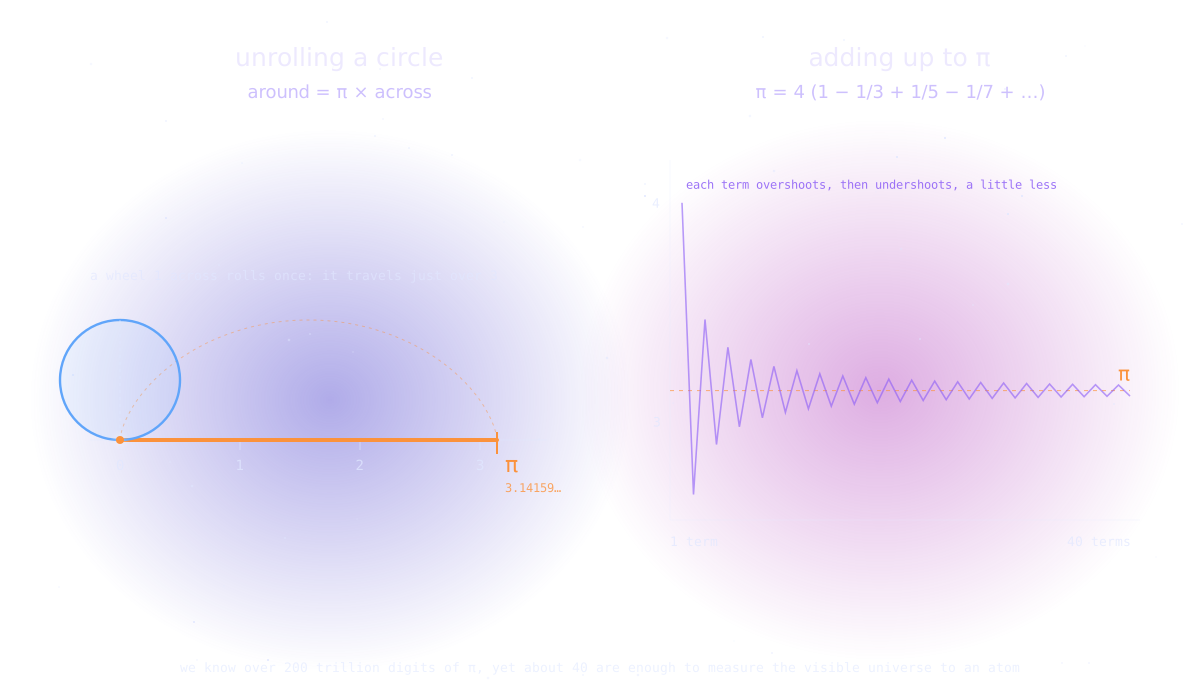
π is how many times a circle's width fits around it: roll a wheel one turn and it travels just over three widths. It never ends or repeats, yet simple sums like 4 (1 − 1/3 + 1/5 − …) creep ever closer to it.
Riemann
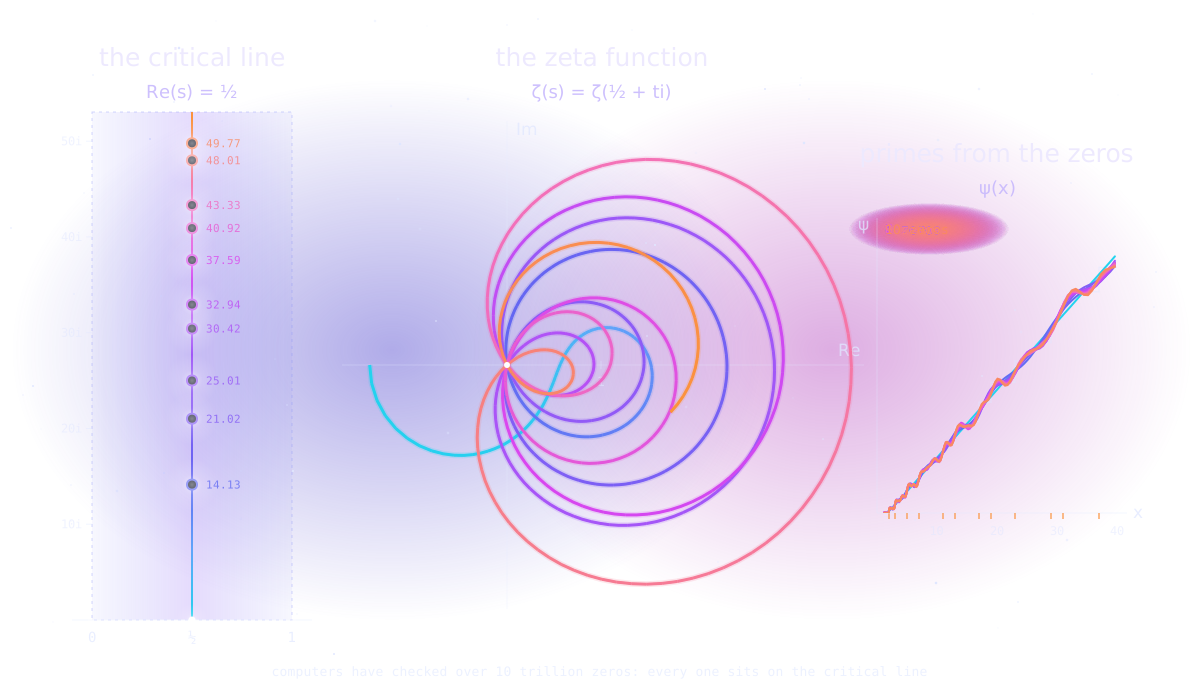
Every zero of ζ on the critical line Re(s) = ½ adds a wave that sharpens the count of the prime numbers. In primes from the zeros, ψ(x) is a staircase that steps up at every prime (and prime power) up to x: the smooth curve is rebuilt from the zeros alone, and each new zero brings it closer to the exact steps. Zeta shows where this function and its ½ line come from.
Zeta
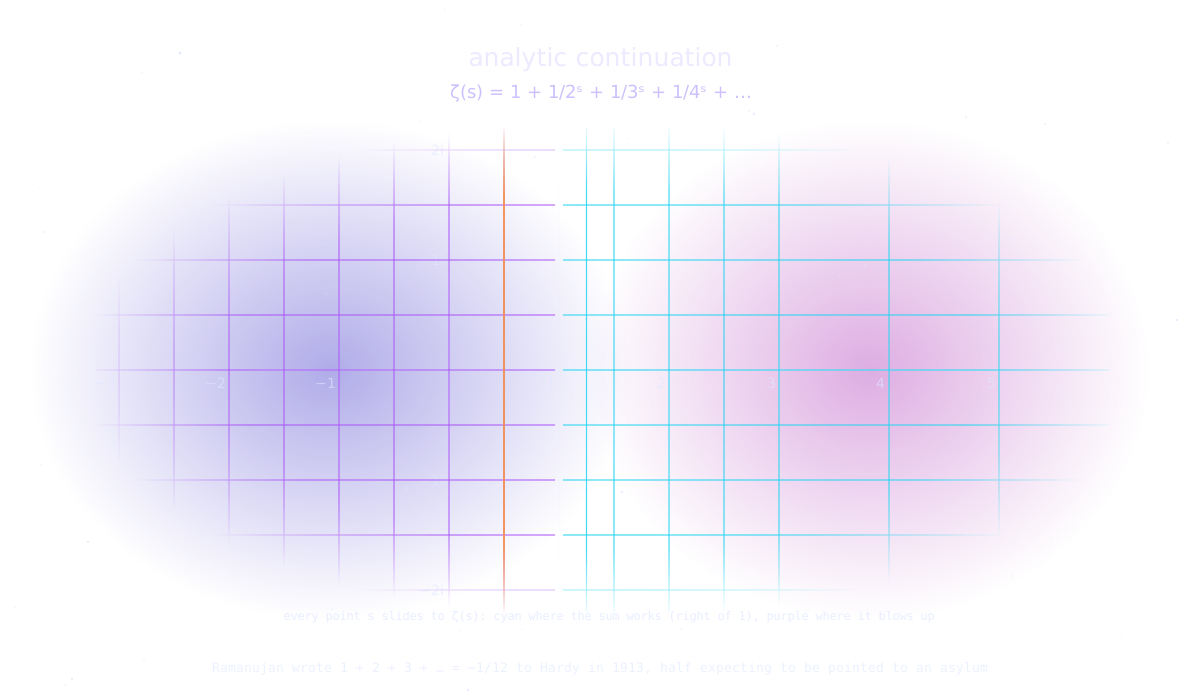
The sum 1 + 1/2ˢ + 1/3ˢ + … only works for s to the right of 1, but there is only one smooth way to carry it on, like the one piece that fits a jigsaw: every point s slides to ζ(s) and the straight grid bends into arcs. At s = −1, where the sum would read 1 + 2 + 3 + …, it lands on −1/12, and the orange line Re s = ½ winds through 0 at every zero of ζ. Riemann shows how those zeros rebuild the count of the prime numbers.
Calculus
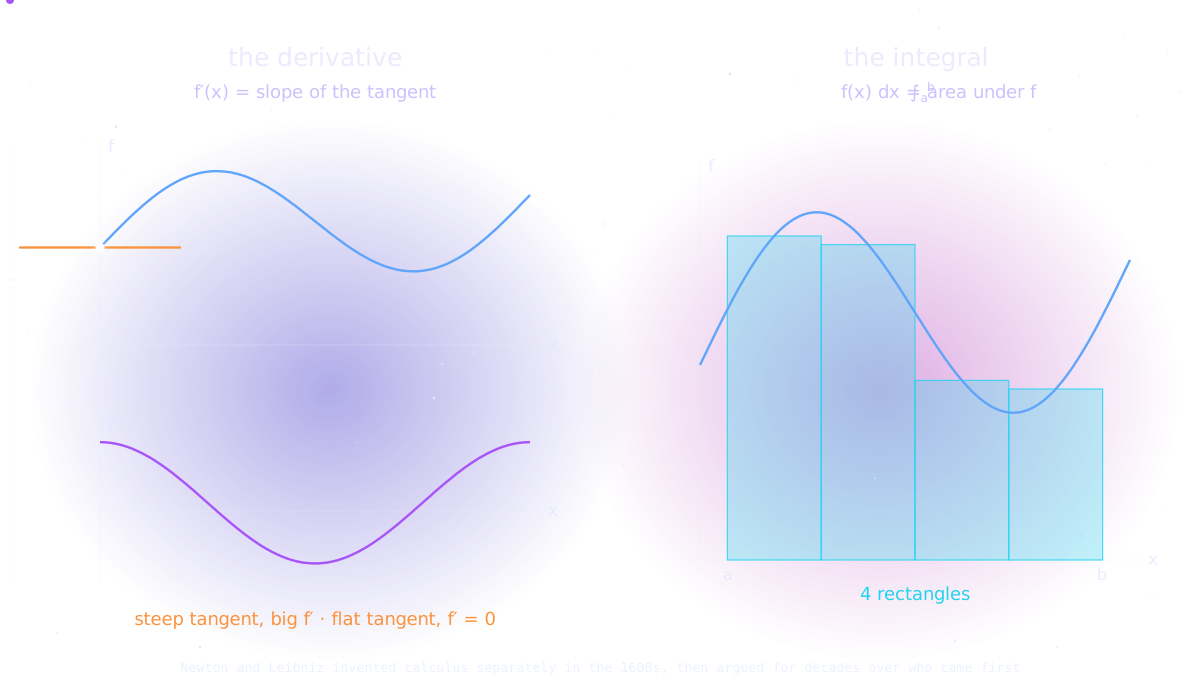
The derivative measures how steep a curve is at each point, the slope of its tangent; the integral adds up the area under it, slice by slice, until the slices are infinitely thin.
Convolution
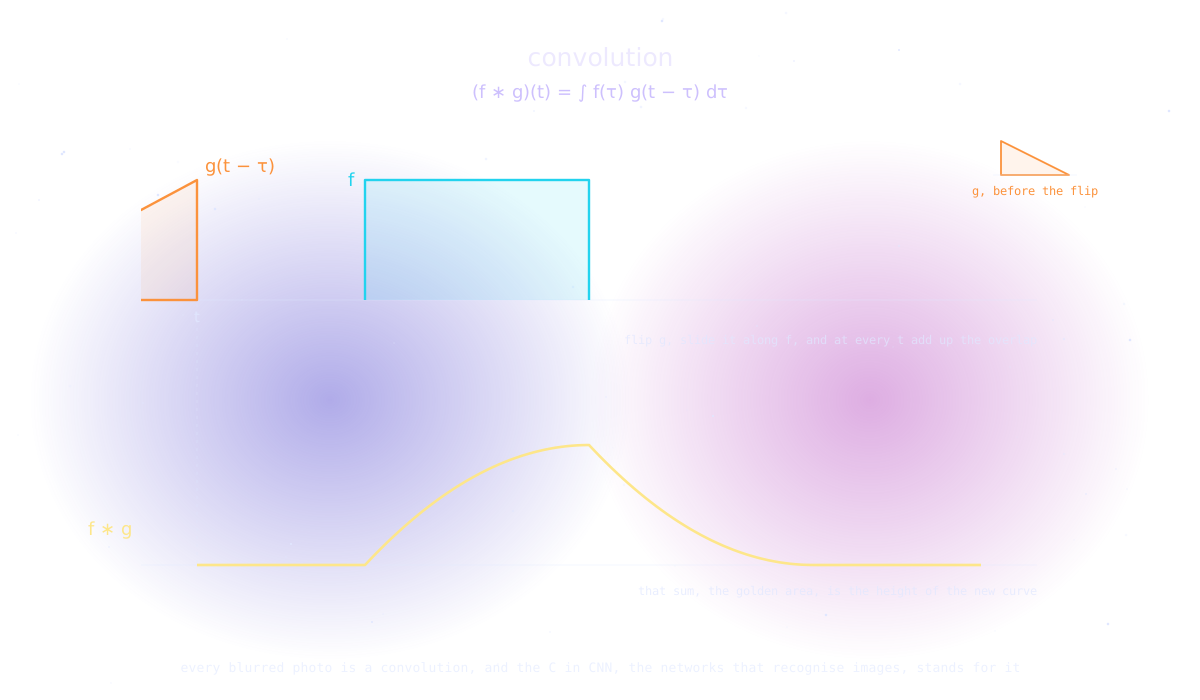
To convolve f with g, flip g, slide it along f, and at every position add up how much the two overlap. That running sum is a new curve, f ∗ g: here a box and a slope blend into a smooth hump. Blurring a photo, adding an echo to a sound and the layers of image-recognising networks all work this way.
Fourier
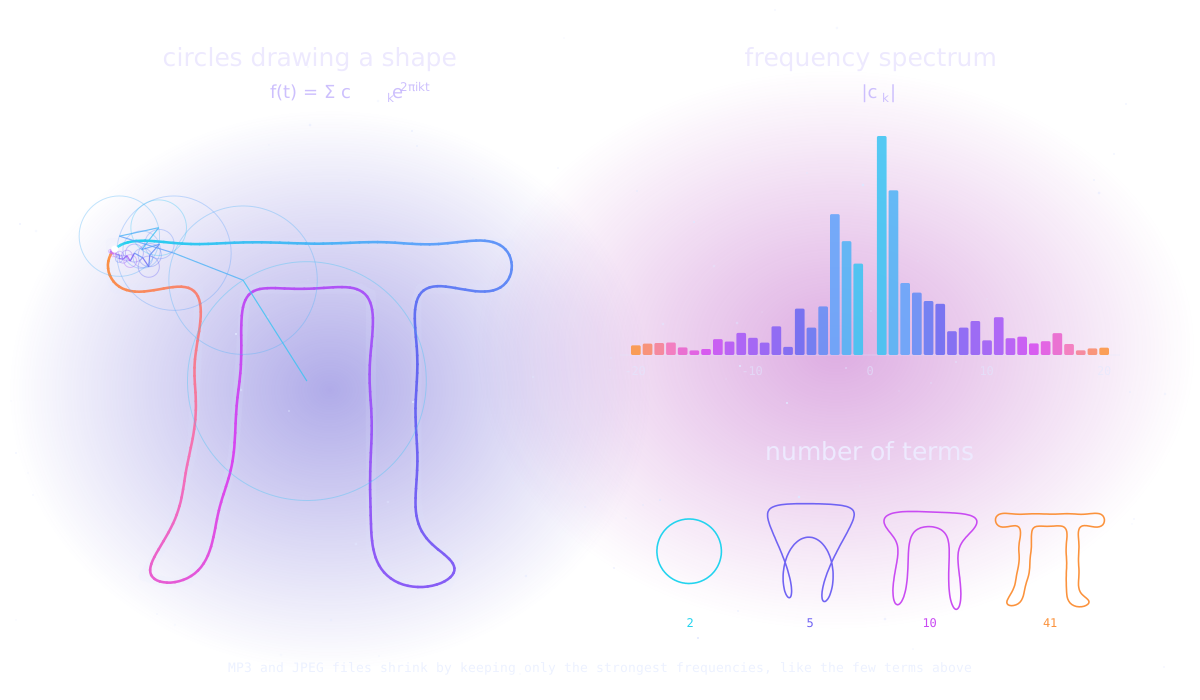
Spinning circles, one per frequency, add up to draw any closed shape, and a handful of the strongest already gets close.
Laplace
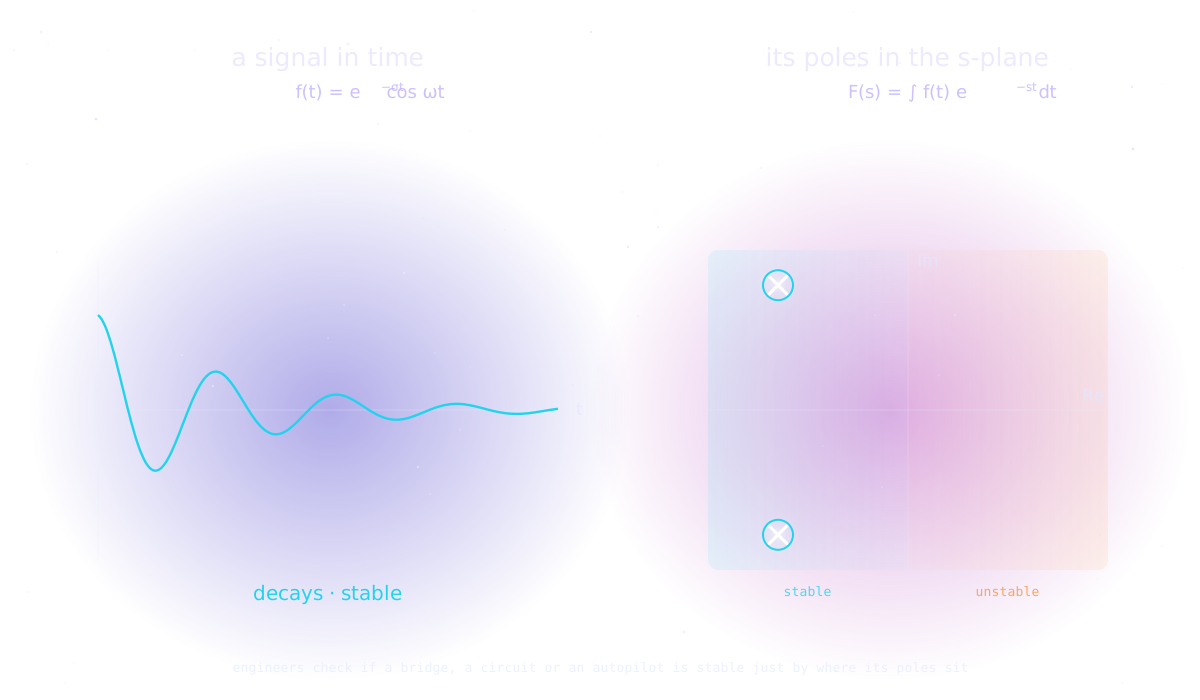
The Laplace transform turns a signal in time into a few points, its poles, in the s-plane: poles on the left mean it dies out, on the axis it rings forever, and on the right it grows without limit.
Partial
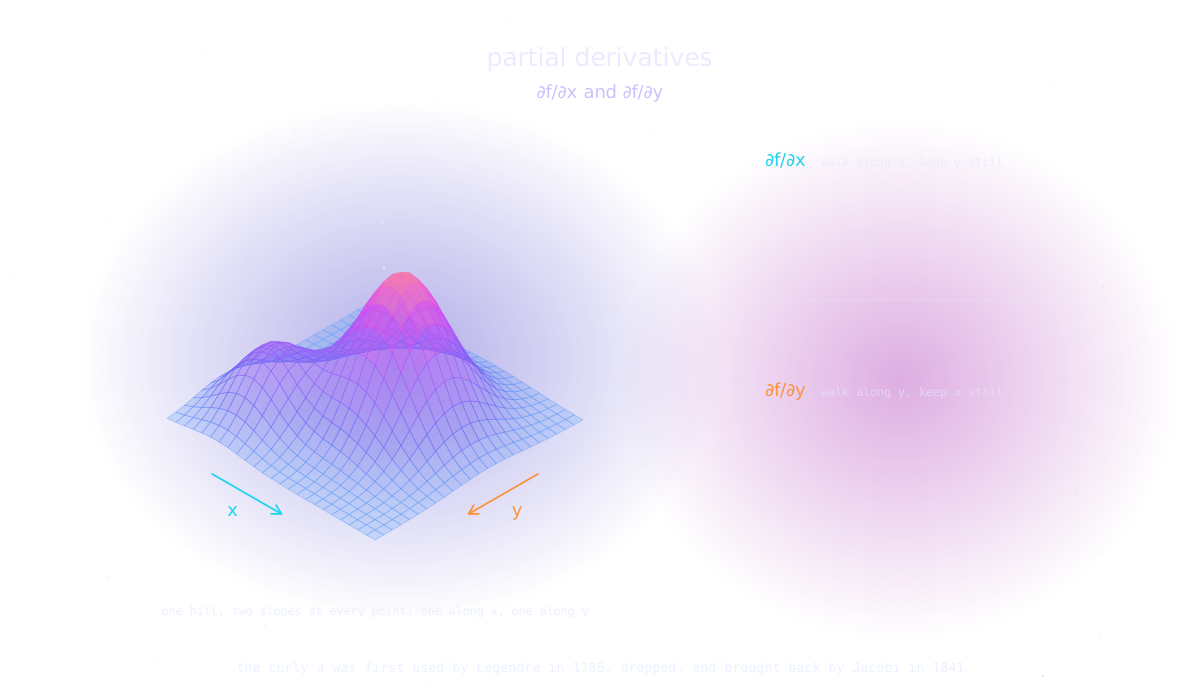
On a hill every point has more than one slope. A partial derivative picks one direction and holds the other still: cut the hill along x and measure how steep that slice is, then do the same along y. At the very top both slopes are flat.
Lorenz
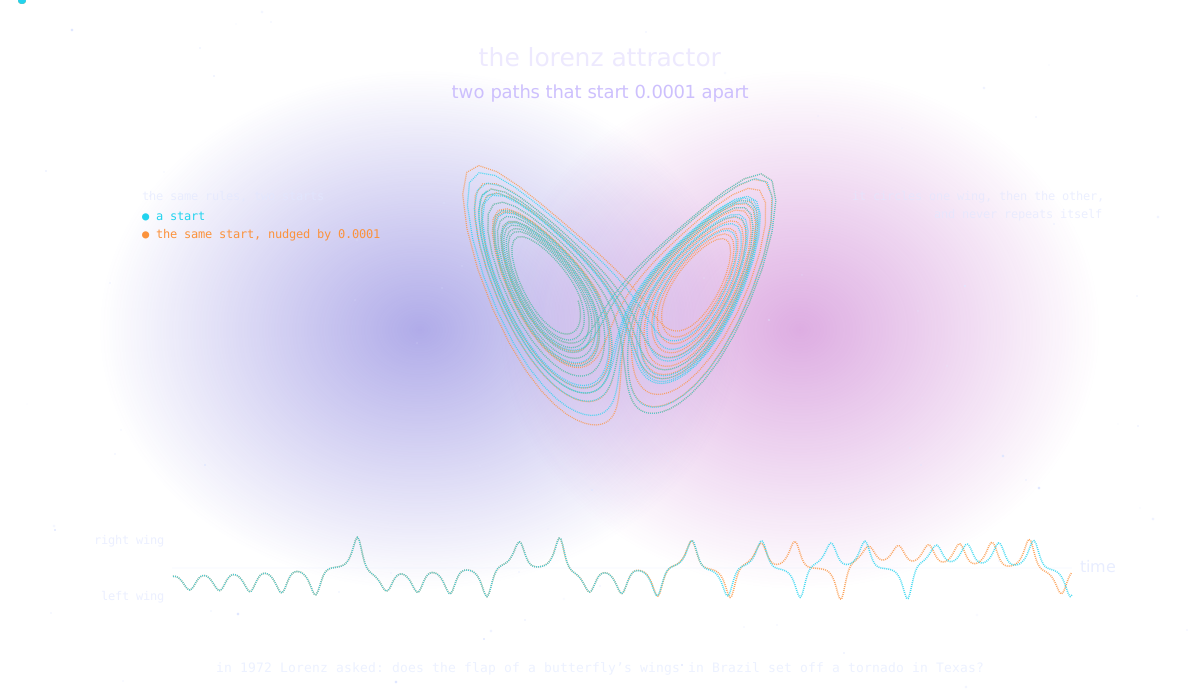
Edward Lorenz found this shape in 1963 in a tiny model of the weather. Two paths that start just 0.0001 apart follow the same rules and stay together for a while, then go completely different ways: the butterfly effect, and the reason weather can't be forecast far ahead.
Pendulum
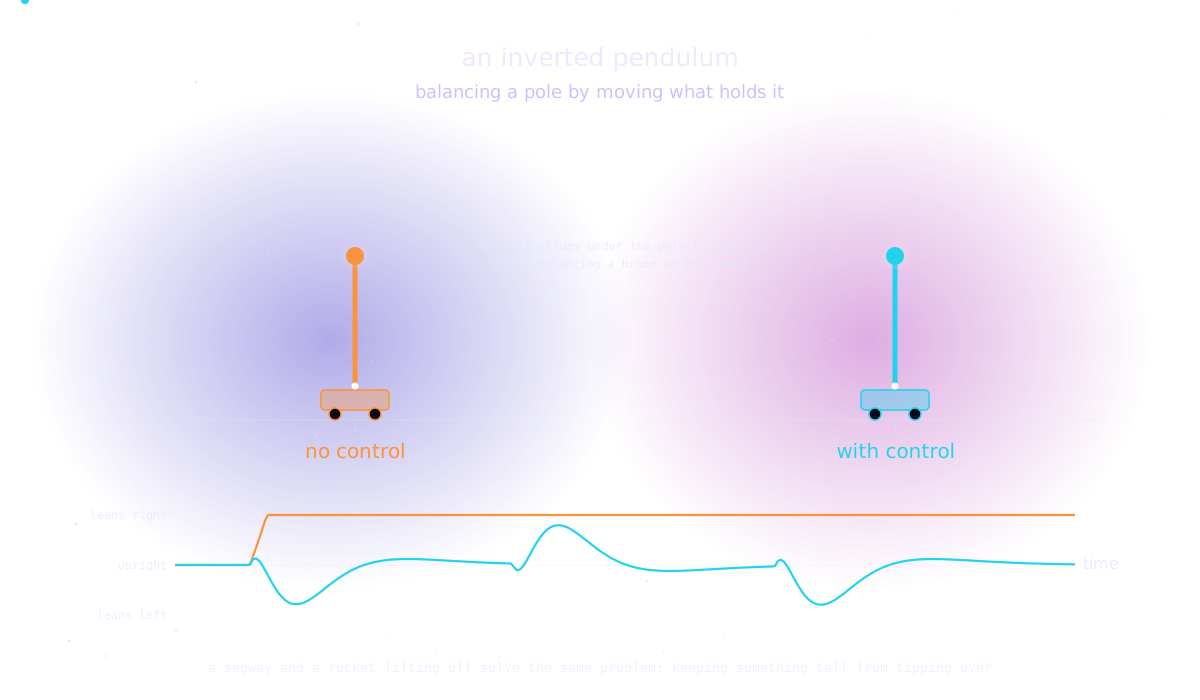
A pole standing on a cart wants to fall over, like a broom balanced on your hand. Without control the first push knocks it down. With control the cart slides under the pole whenever it starts to lean, and it stays upright through every push.
PID
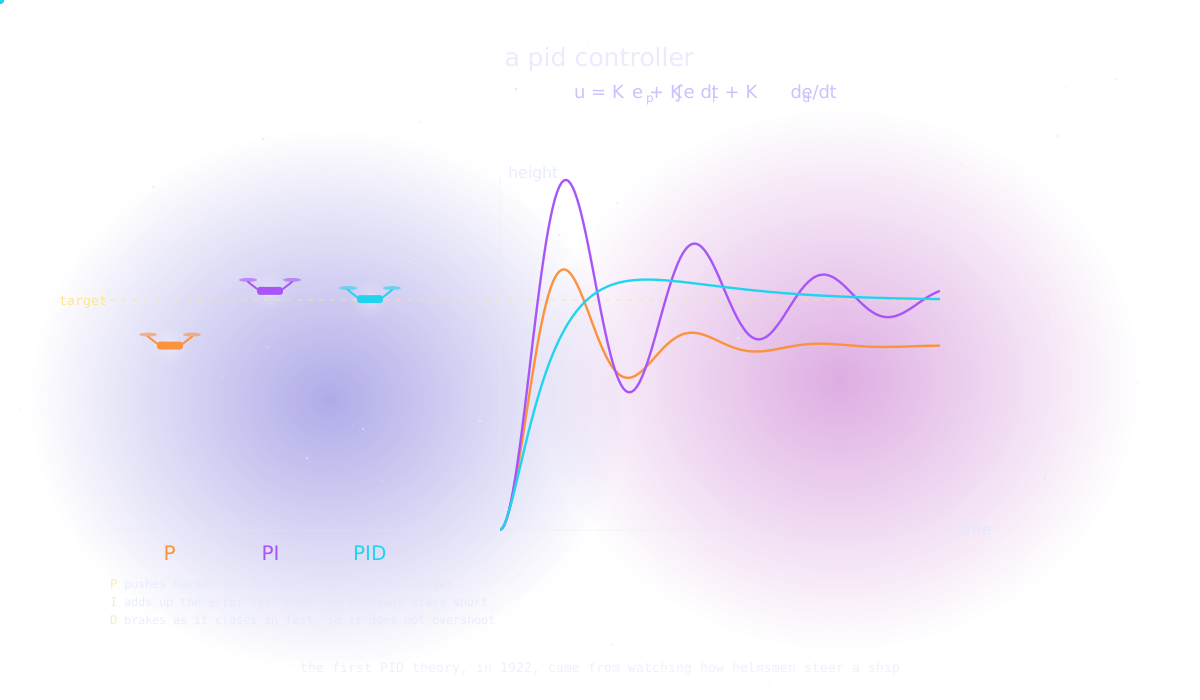
A PID controller steers a system to a target by looking at the error three ways: how big it is now (P), how much has built up (I) and how fast it is changing (D). P alone falls short, adding I reaches the target but overshoots, and adding D brings it in smoothly.
Doppler
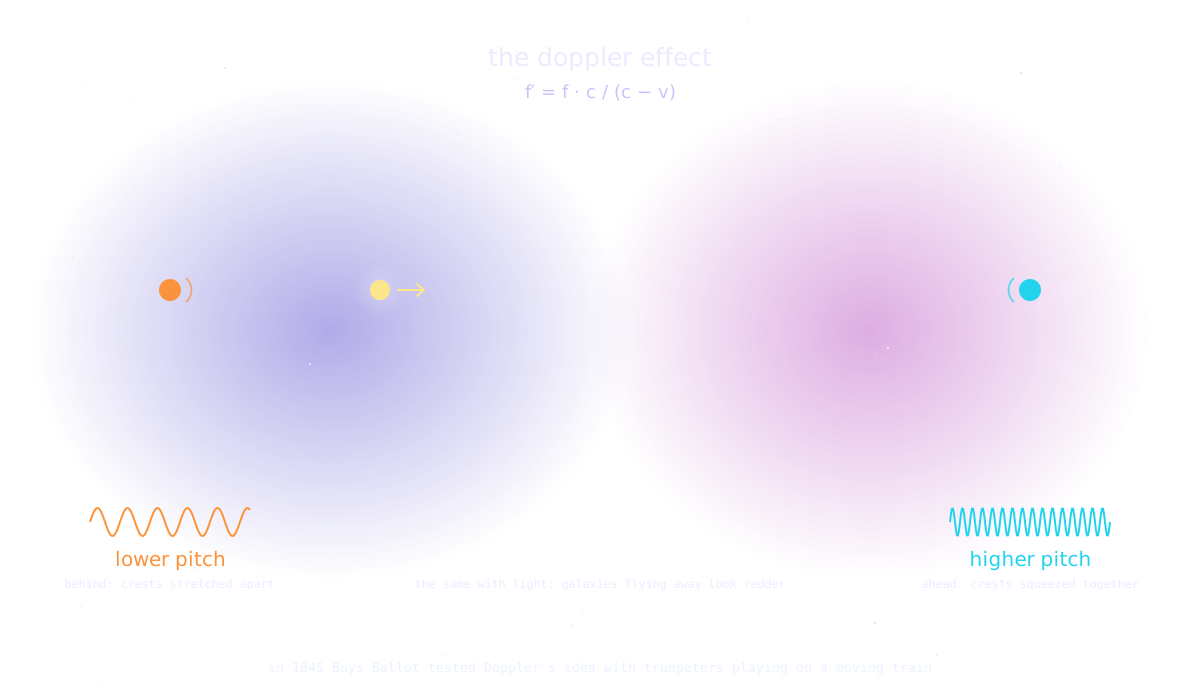
A moving source keeps catching up with the waves it sends forward and running away from the ones it sends back. Ahead the crests arrive squeezed together and the pitch rises, behind they arrive stretched and it falls: the change you hear as an ambulance passes. Light does the same, and galaxies moving away look redder.
Electromagnetic
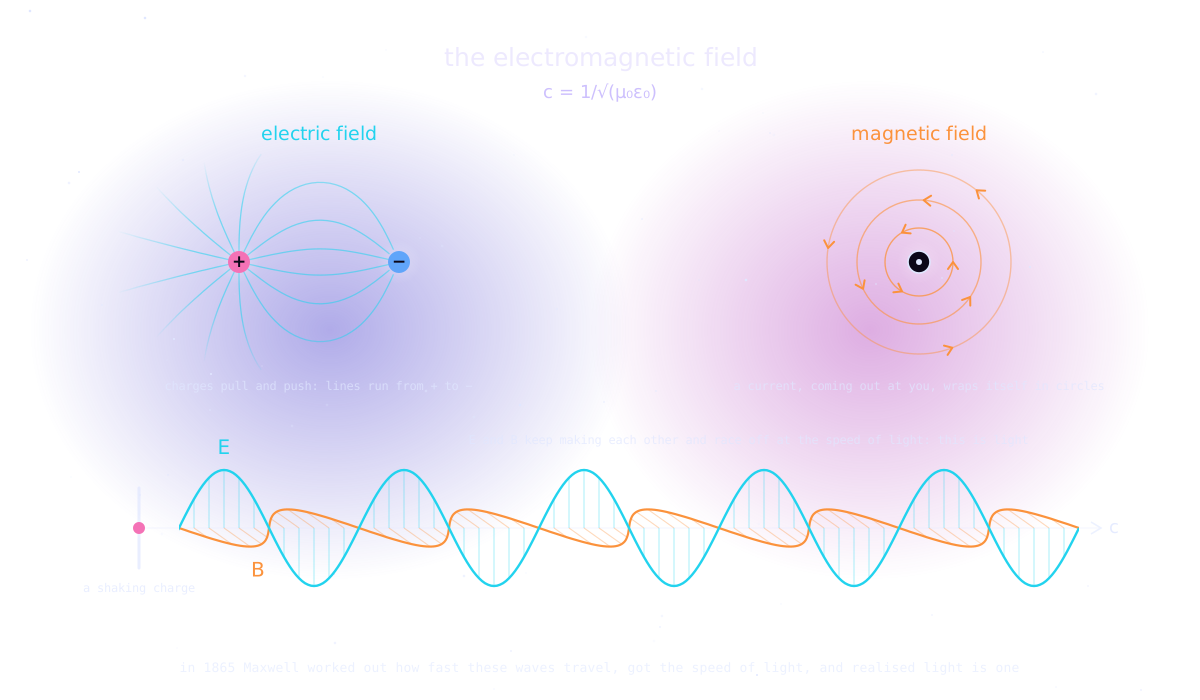
Charges fill the space around them with an electric field, running from + to −, and moving charges, a current, wrap themselves in a magnetic field. Shake a charge and both ripple outwards together, each one making the other, at the speed of light: that ripple is light, and radio, and X-rays.
Entropy
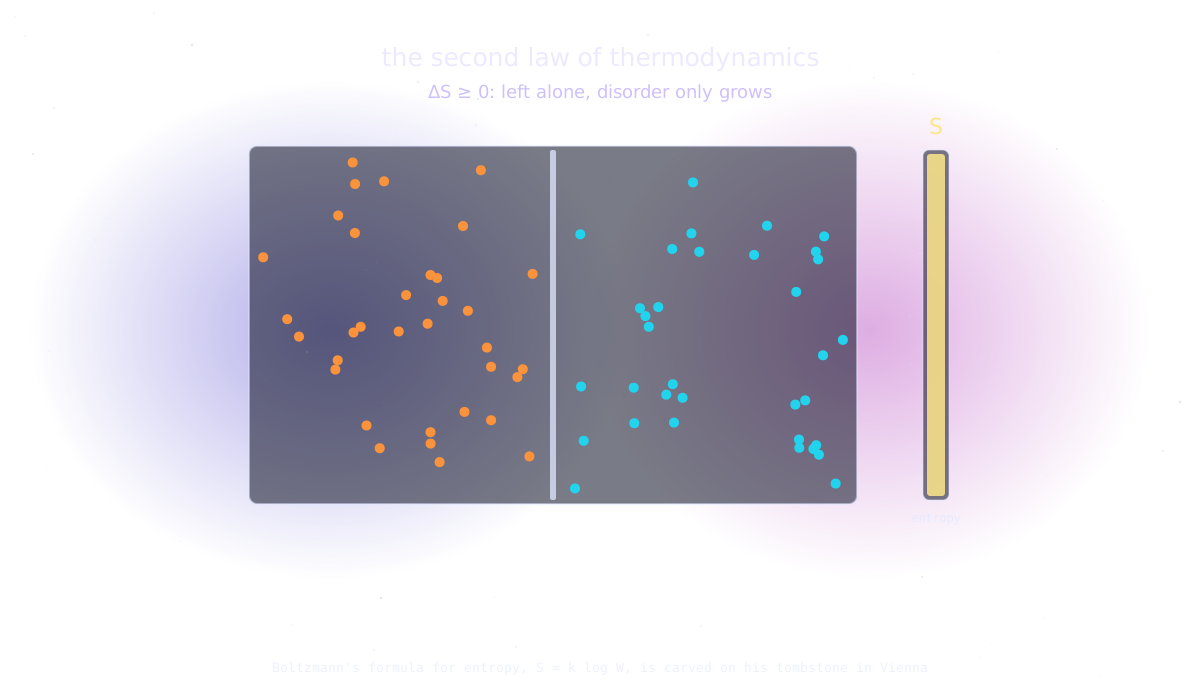
Heat is just molecules moving: fast ones are hot, slow ones are cold. Let them meet and they spread out and share their speed until everything is evenly warm, and they never sort themselves back. That one-way slide towards disorder, entropy, is the second law of thermodynamics, and it is why time has a direction.
Forces
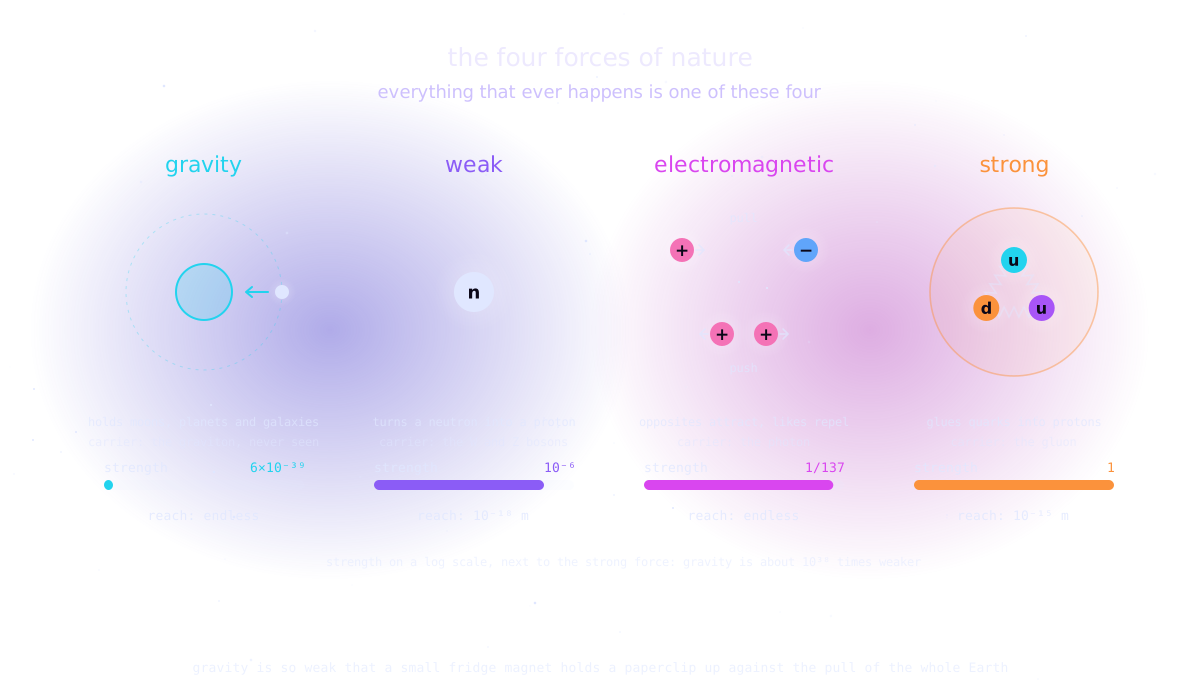
Everything that happens in the universe comes down to four forces. Gravity is by far the weakest, yet it reaches forever and never cancels, so it rules planets and galaxies. Electromagnetism holds atoms together, the weak force lets particles change into others, and the strong force, the strongest of all, glues quarks into protons and neutrons but reaches no further than a nucleus.
Light
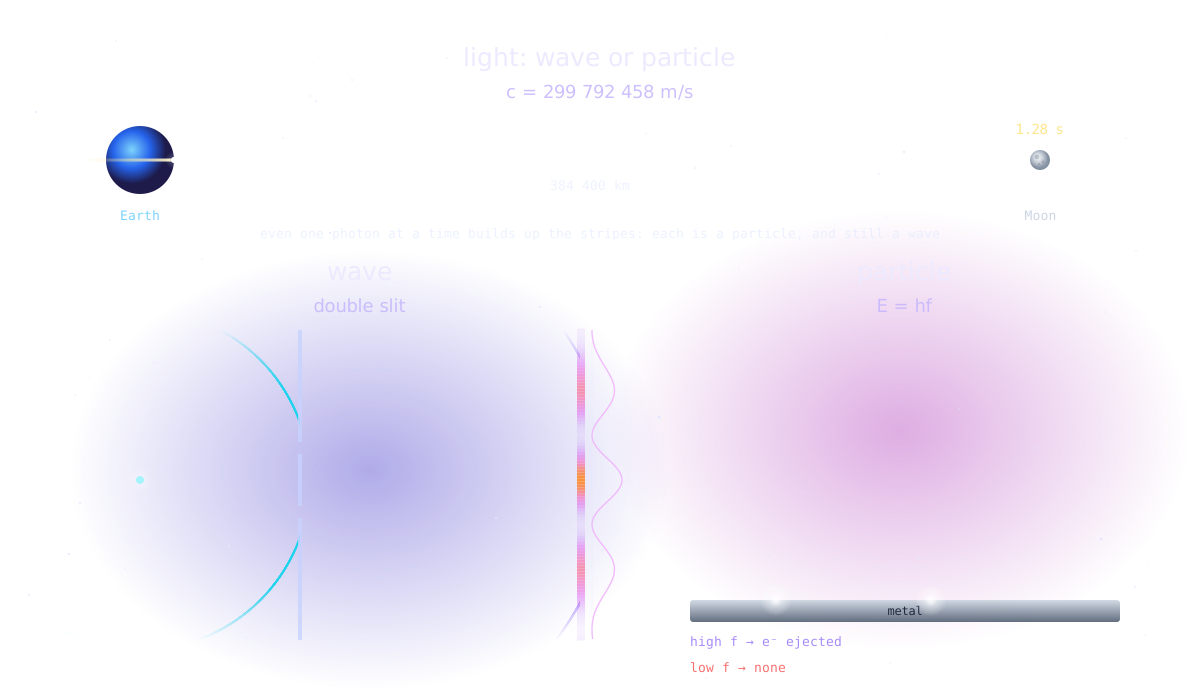
Light covers the 384 400 km to the Moon in 1.28 s, interferes with itself like a wave through two slits, and arrives in packets of energy E = hf that knock electrons out of a metal.
Spectrum
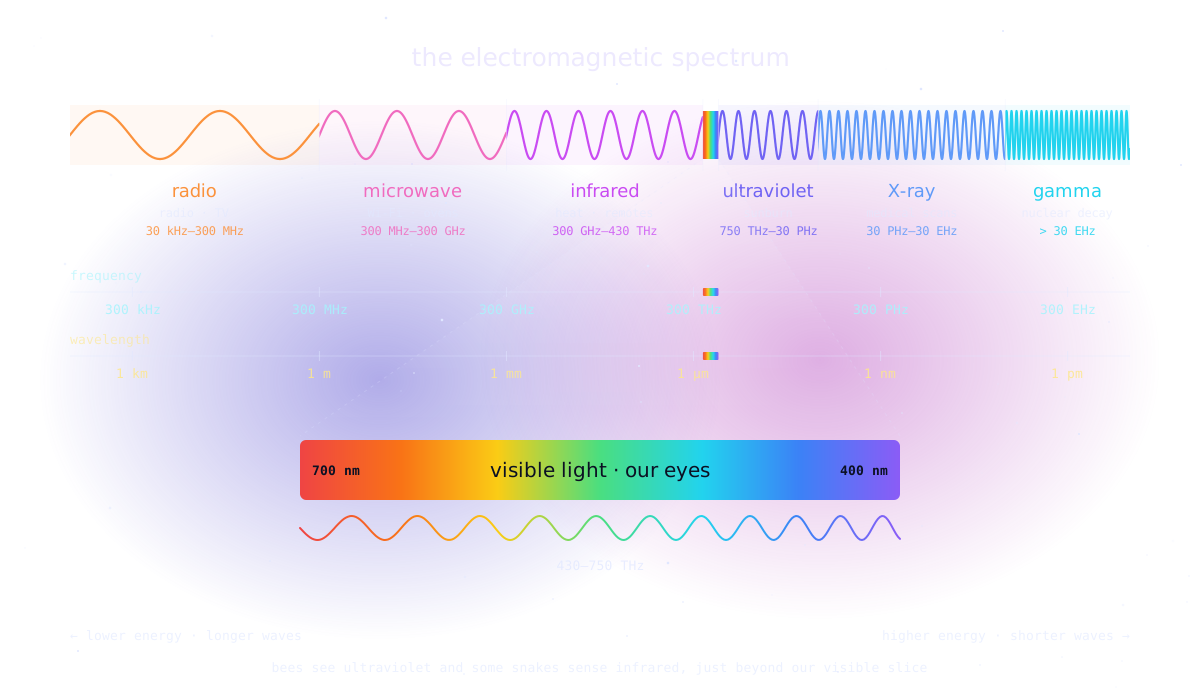
From radio to gamma rays, every kind of light travels at the same speed; shorter waves mean higher frequency and more energy, and our eyes see only a thin slice.
Higgs
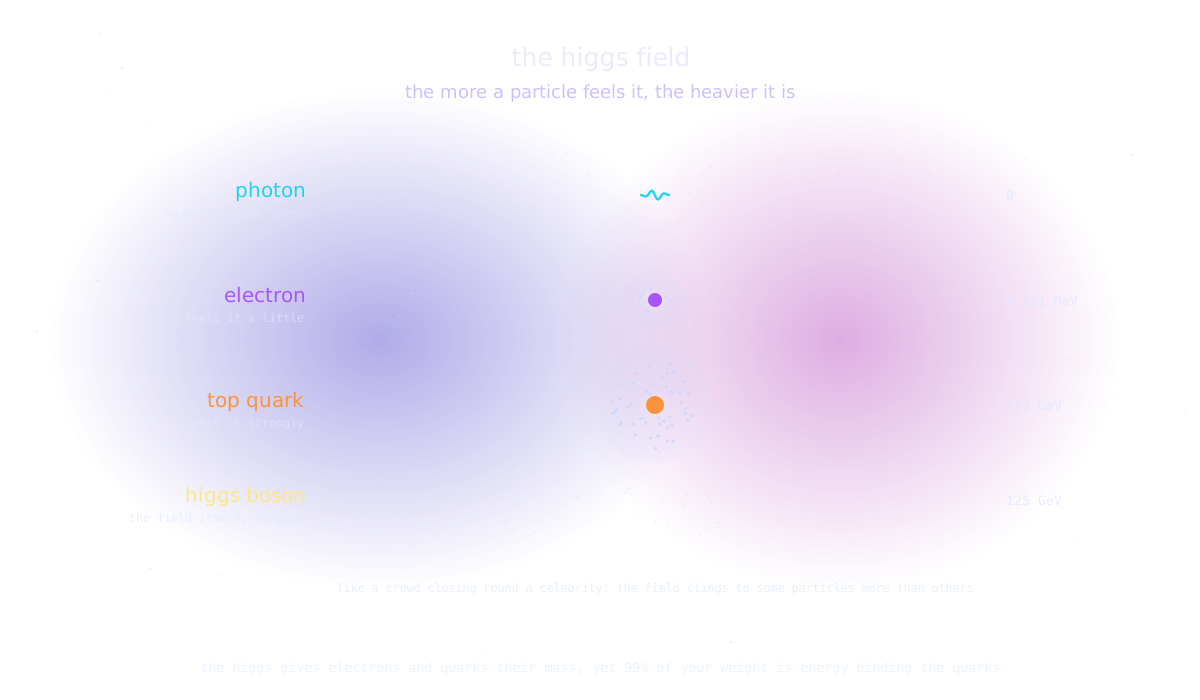
The Higgs field fills all of space. Particles that do not feel it, like light, have no mass and fly at light speed; the more strongly a particle couples to it, the heavier it is, like a crowd closing round a celebrity. Strike the field itself hard enough and it rings: that ripple is the Higgs boson, found at CERN in 2012.
Neutrinos
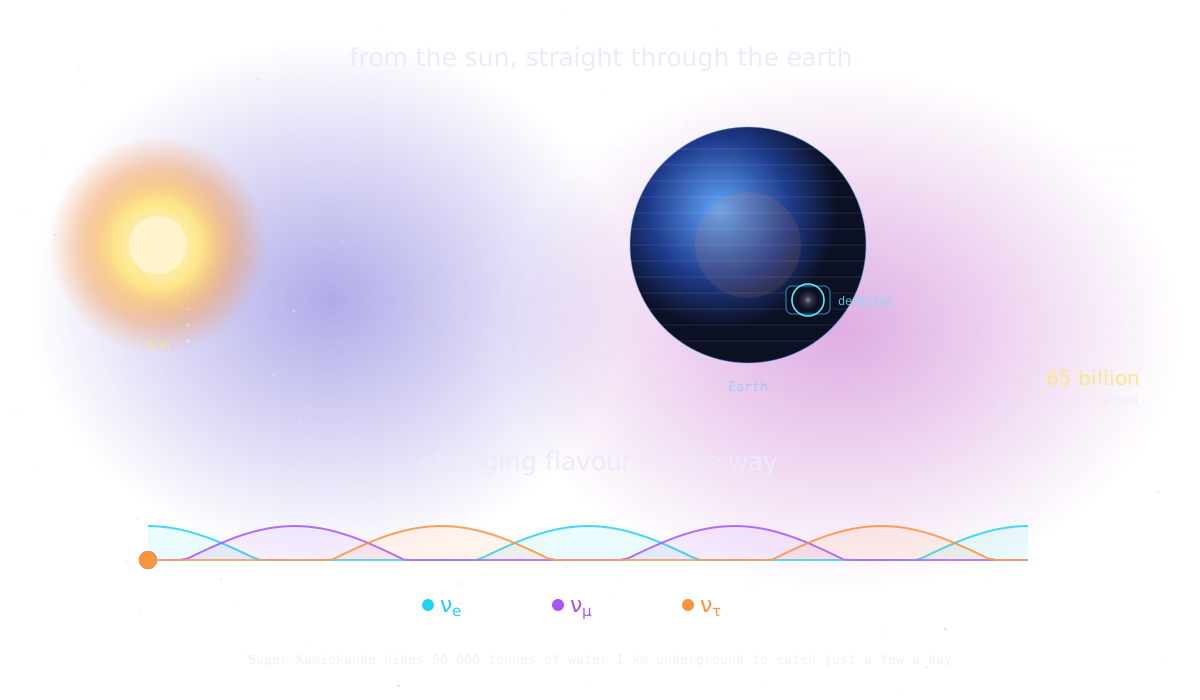
Neutrinos barely interact with matter: billions from the Sun cross every square centimetre of us each second, pass straight through the Earth, and switch between three flavours as they travel.
StandardModel
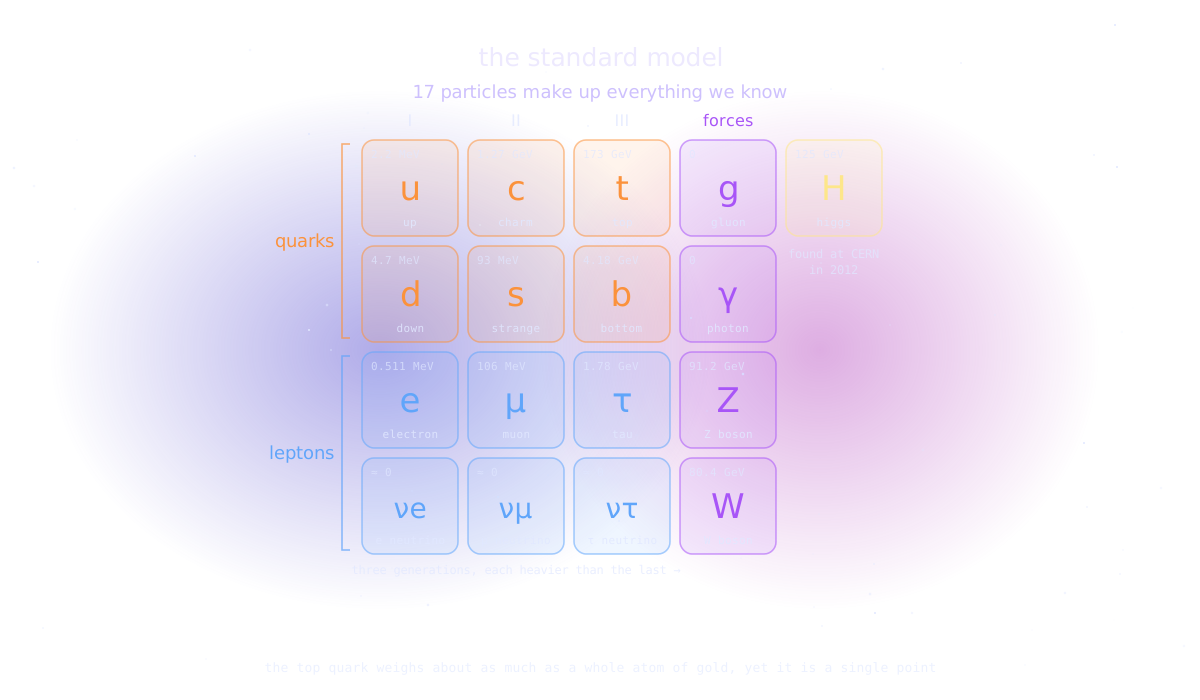
Everything we know is built from just 17 particles. Six quarks and six leptons make up matter, in three generations that grow heavier, though everyday things use only the first. Four force carriers pass the forces between them, and the Higgs boson, found in 2012, comes from the field that gives the others their mass.
Strings
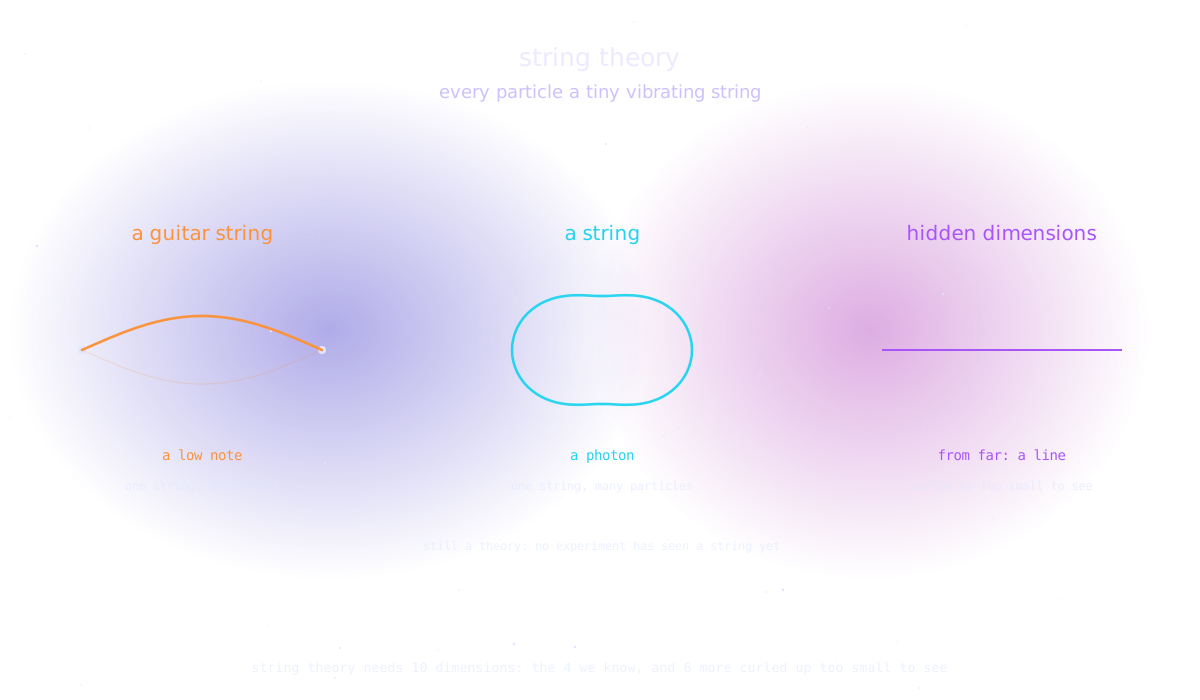
String theory imagines every particle as a tiny vibrating string. Like a guitar string that plays different notes, one string vibrating in different ways would be different particles. It also needs extra dimensions, curled up so small we can't see them, the way a hose looks like a line from far away.
Zeptoverse
Diving into a grain of salt: a lattice of ions, atoms that are almost all empty space, a nucleus of protons and neutrons, three quarks inside each proton, and below that the zeptometre, a billionth of a billionth of a millimetre, beyond what any experiment can see.
DNA
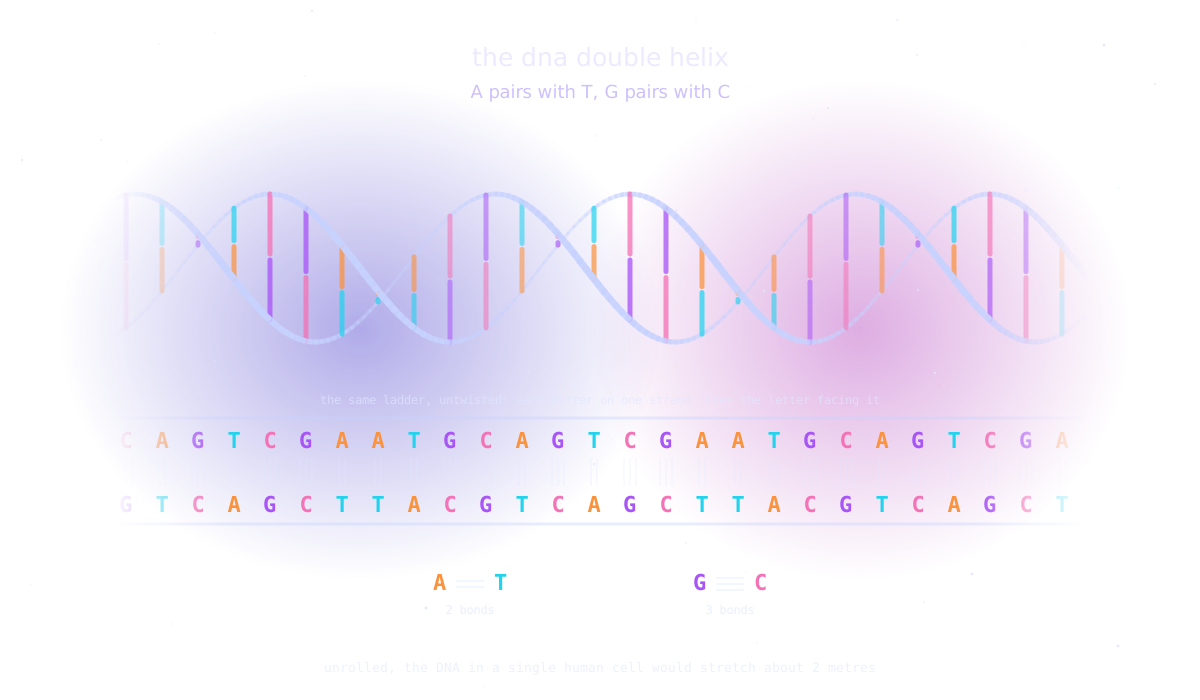
DNA is a twisted ladder: two strands wound round each other, joined by rungs of paired bases. A always pairs with T and G with C, so each strand fixes the other, and a cell can copy itself by splitting the ladder and rebuilding each half. The 3 billion letters of the human genome are written in just these four.
DopplerUltrasound
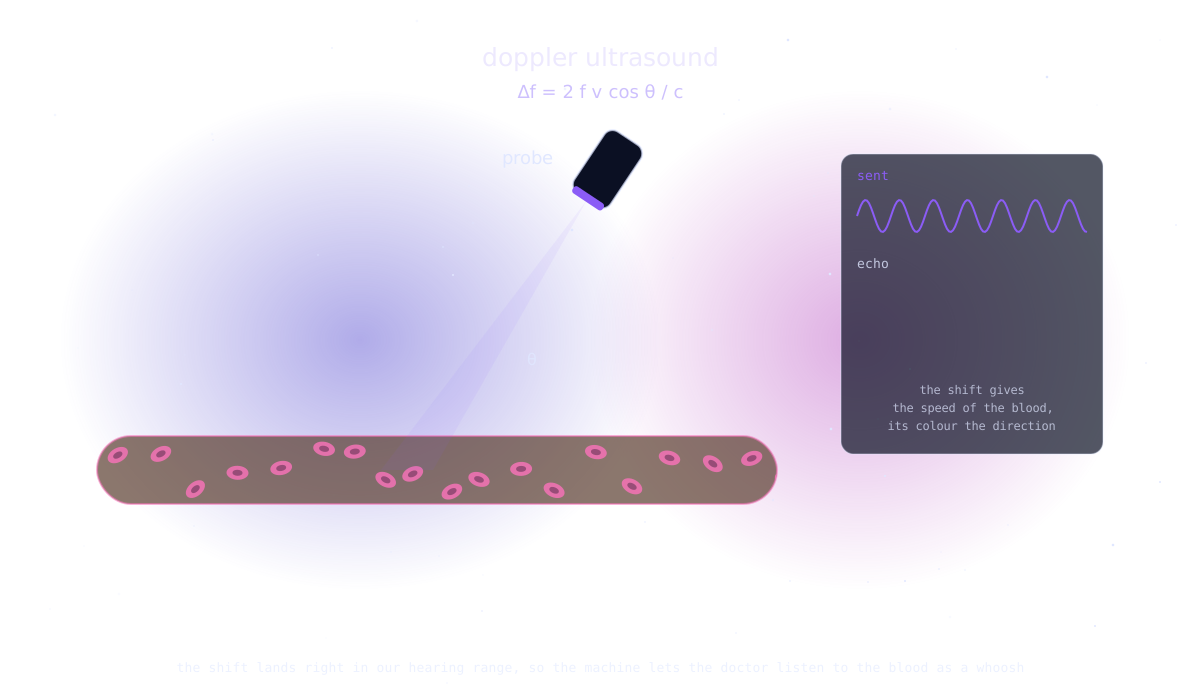
A Doppler ultrasound sends sound into the body and listens to the echoes bouncing off red blood cells. Cells flowing towards the probe send the echo back squeezed, a little higher in pitch; cells flowing away send it back stretched and lower. From that shift the machine works out how fast the blood moves, and paints each direction in its own colour.
Neuron
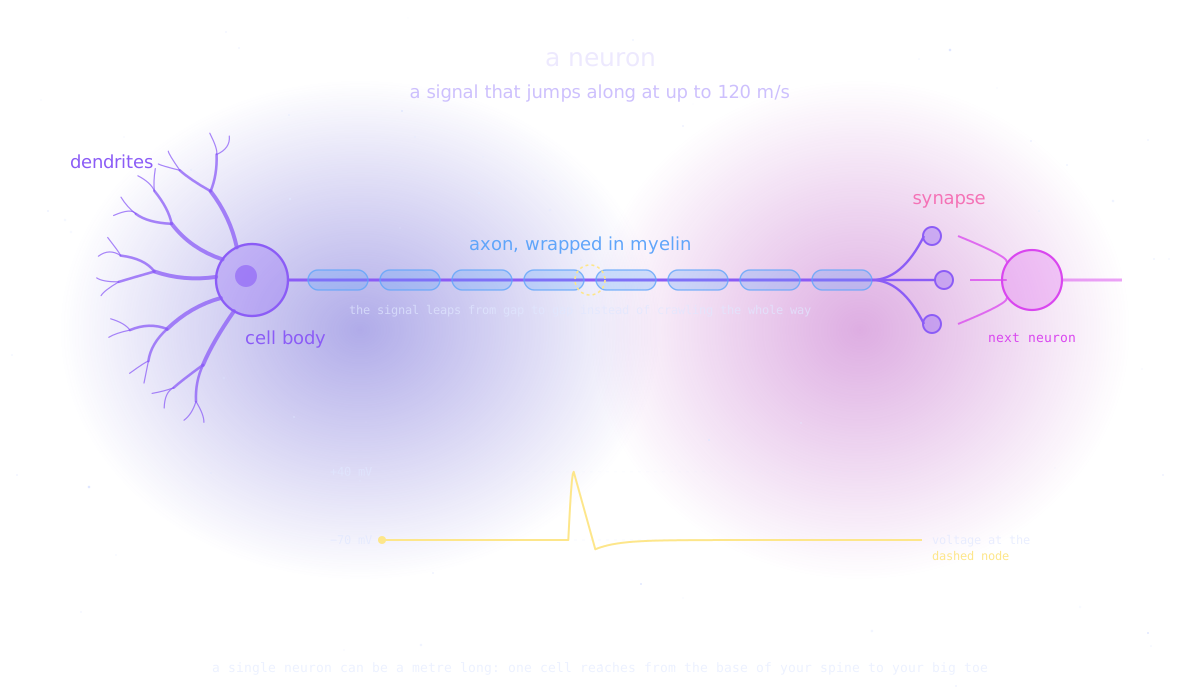
A neuron listens through its branching dendrites and, when enough signals add up, fires. The impulse races down the axon, leaping between the gaps in its fatty myelin coat instead of crawling the whole way, and at the synapse it turns into chemicals that cross to the next neuron. At any point along the way the voltage spikes from −70 to +40 millivolts and back in about a millisecond.
TreeOfLife
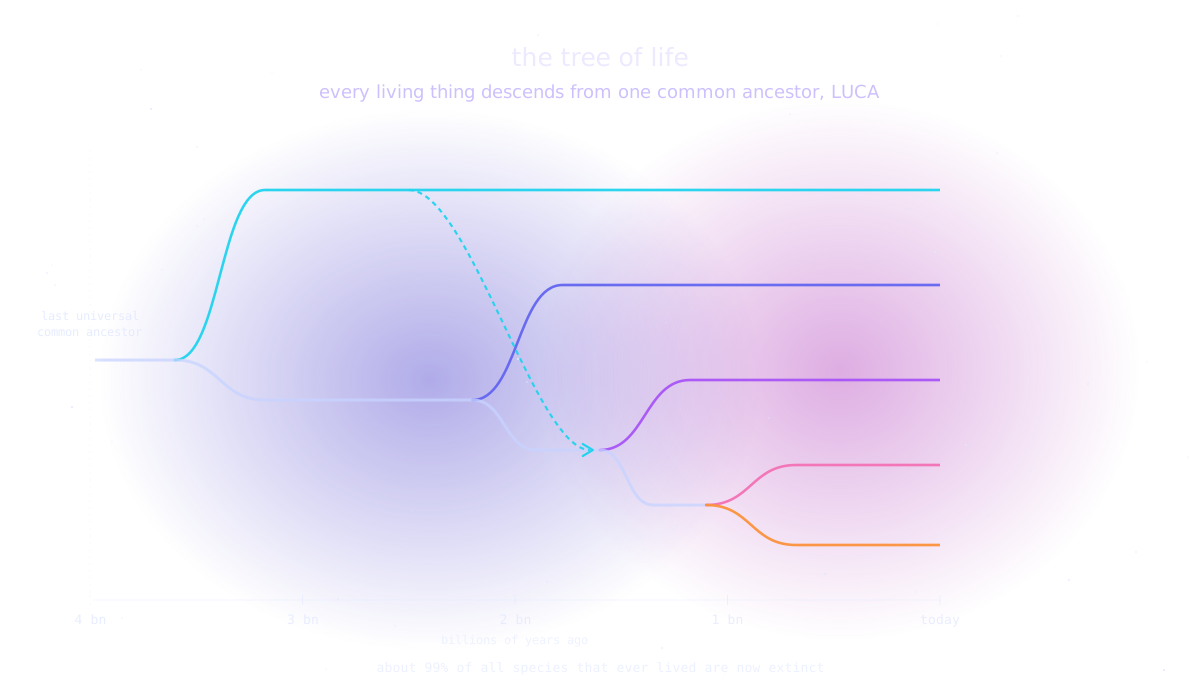
All life shares one ancestor, LUCA, that lived about four billion years ago: its tree split into bacteria and archaea, and the eukaryotes, born when an archaeon took in a bacterium that became the mitochondria, later branched into plants, fungi and animals.
Layers
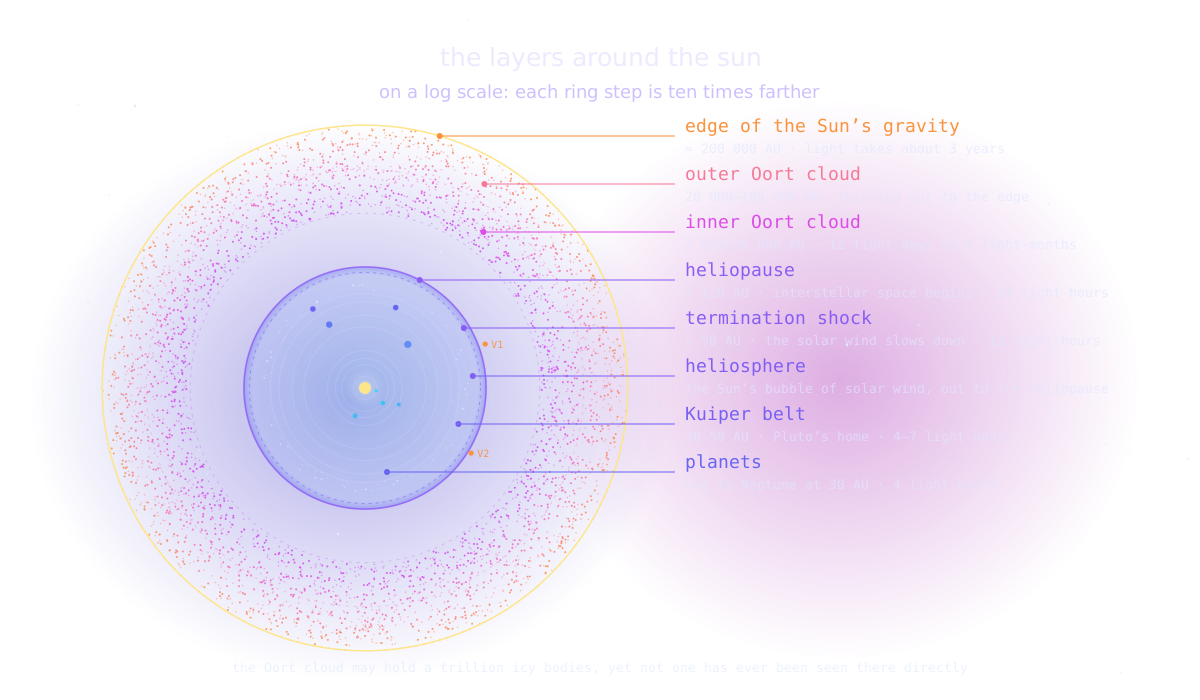
Around the Sun, layer after layer: the planets, the Kuiper belt, the bubble of solar wind that ends at the heliopause, then the vast Oort cloud of icy bodies, out to where the Sun's gravity gives way to the stars.
SolarSystem
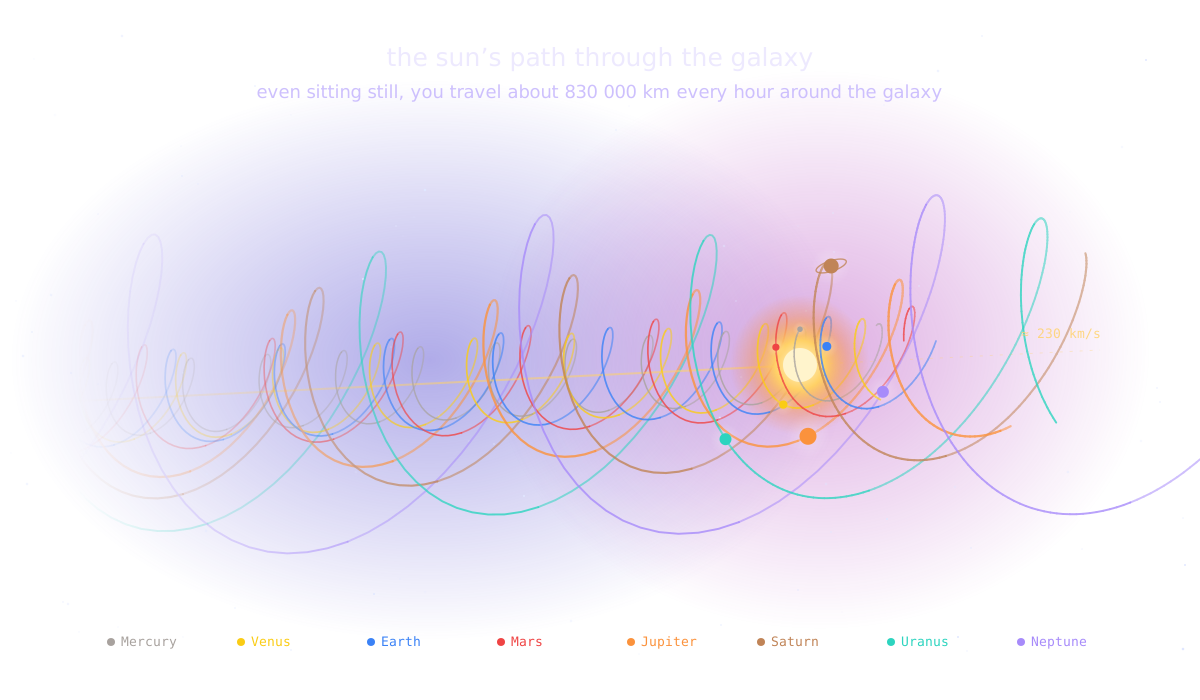
As the Sun travels through the galaxy, each planet traces a helix around its path.
Voyagers
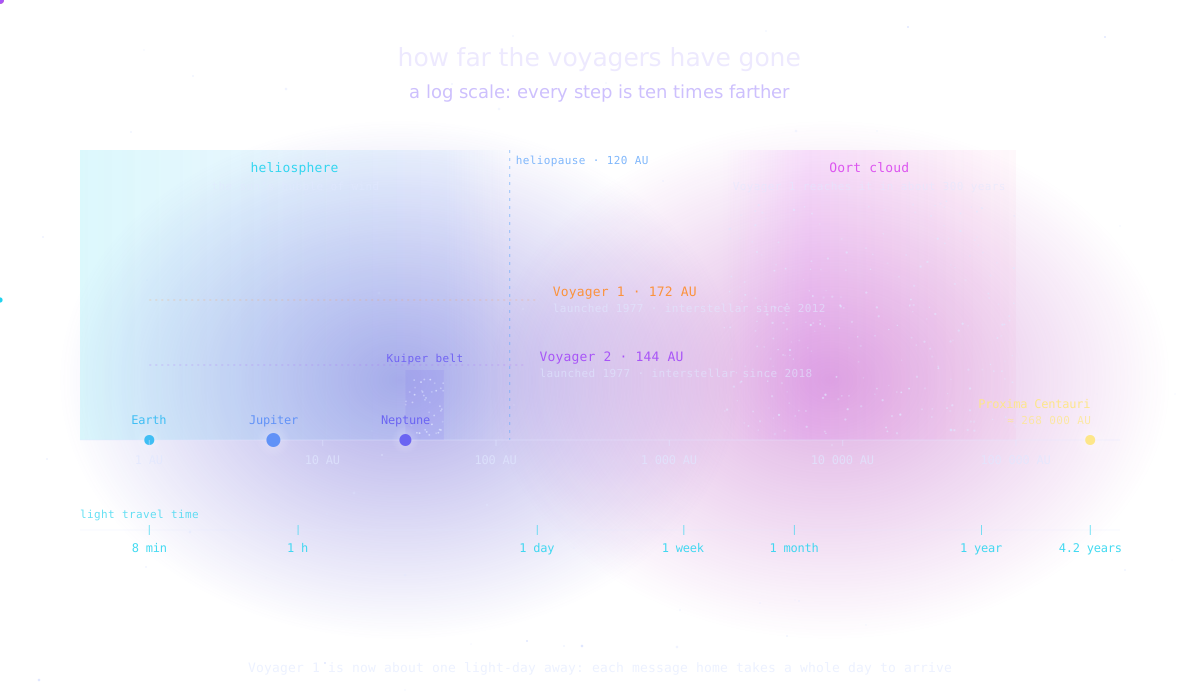
Launched in 1977, both Voyagers have left the Sun's bubble of wind and are now in interstellar space, yet the Oort cloud still lies centuries ahead and the nearest star tens of thousands of years away.
BlackHole
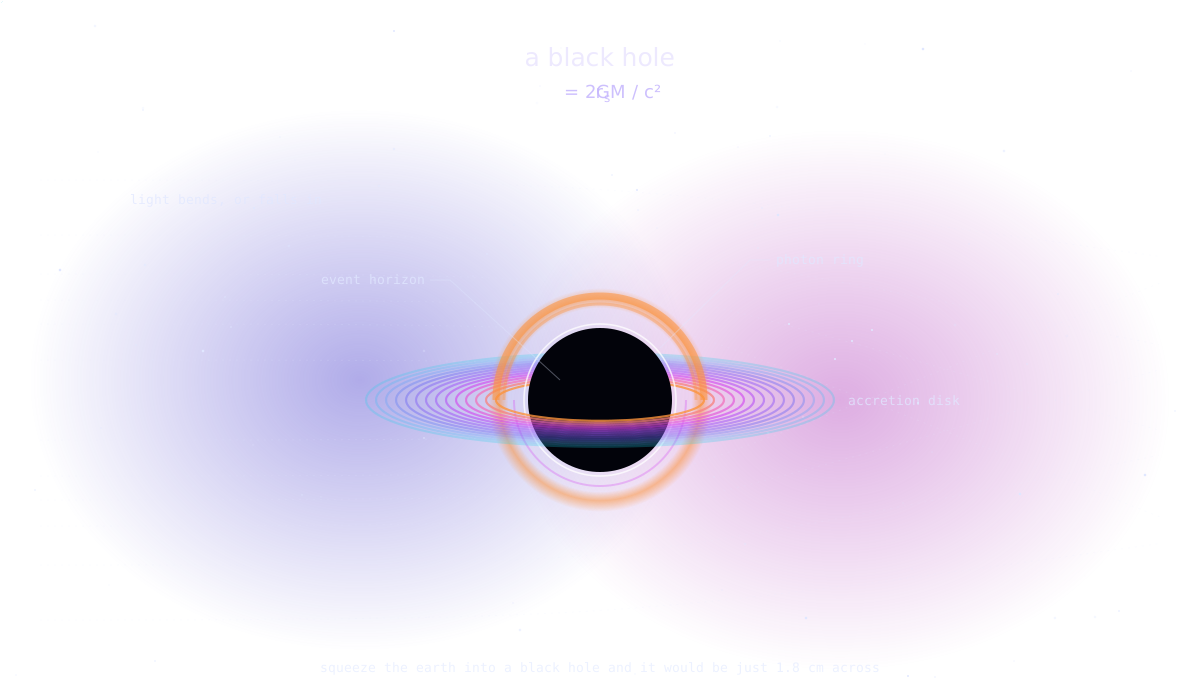
Nothing that crosses the event horizon comes back, not even light: rays that pass close are bent around the hole, closer ones fall in, and the hot disk of gas glows as it spirals inwards.
GravitationalWaves
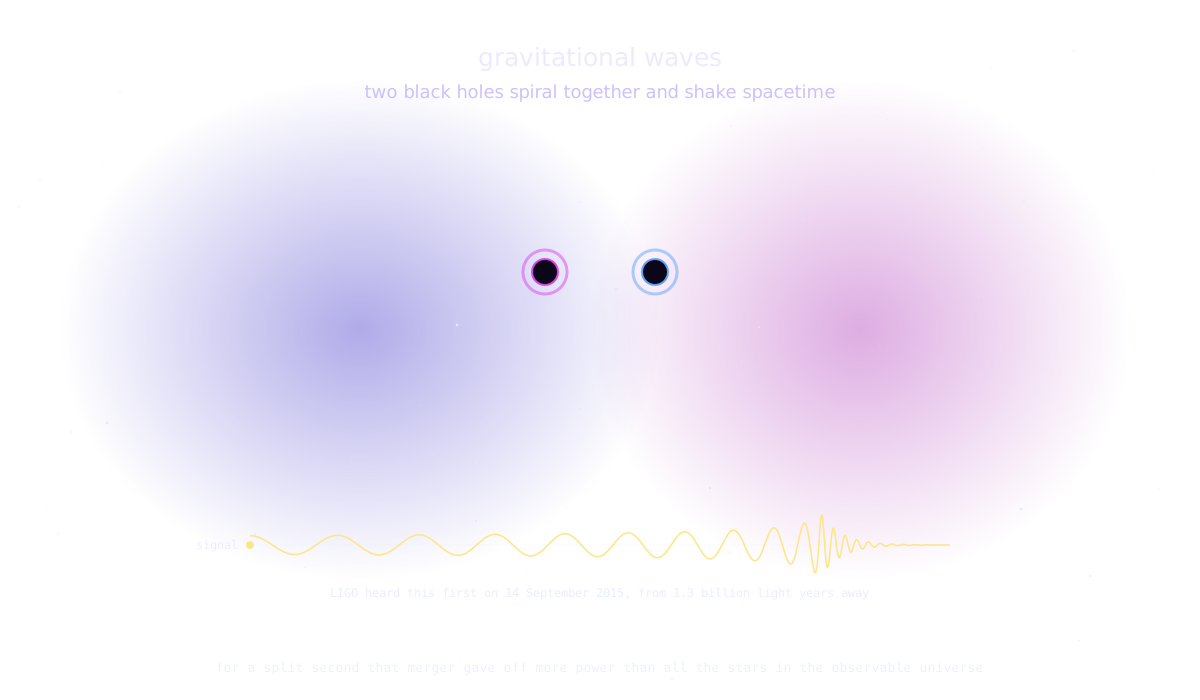
Two black holes orbiting each other stir spacetime itself, sending out ripples that carry energy away. The orbit shrinks, they whirl faster, and the ripples come quicker and stronger until the holes merge and the new one rings like a struck bell. On Earth that arrives as a chirp, a signal rising in pitch, first caught by LIGO in 2015.
MilkyWay
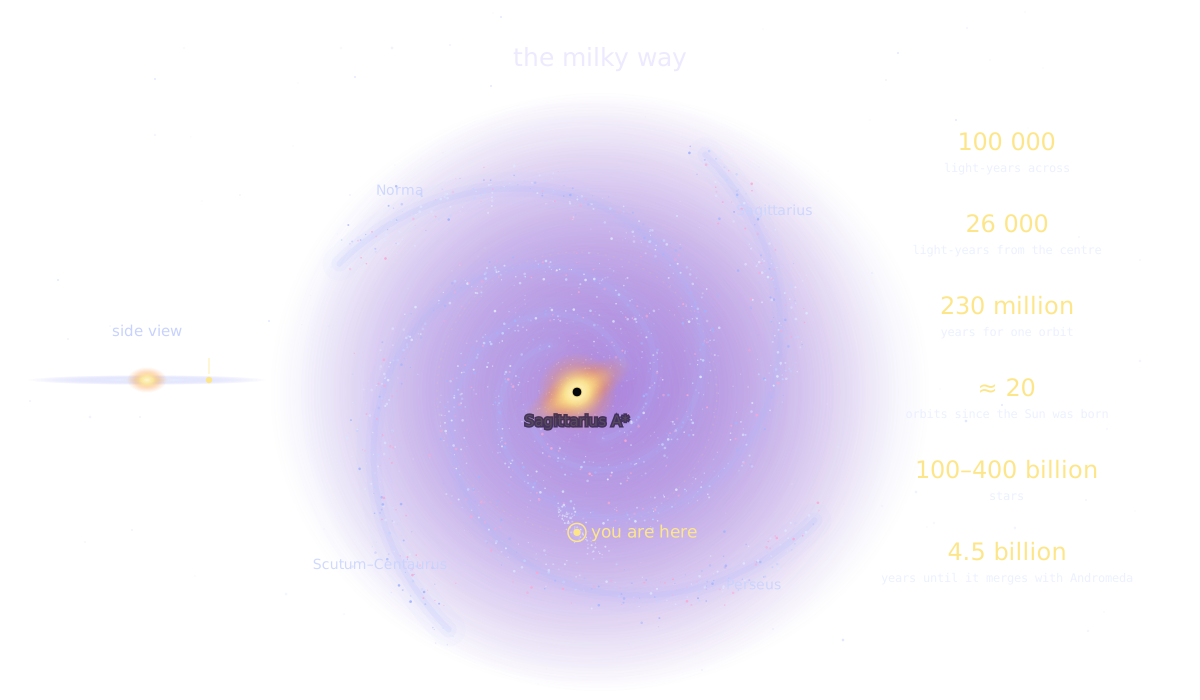
Our galaxy is a barred spiral about 100 000 light-years across; the Sun sits on a small spur between two arms, 26 000 light-years from the centre, and takes 230 million years to go round once.
Neutron
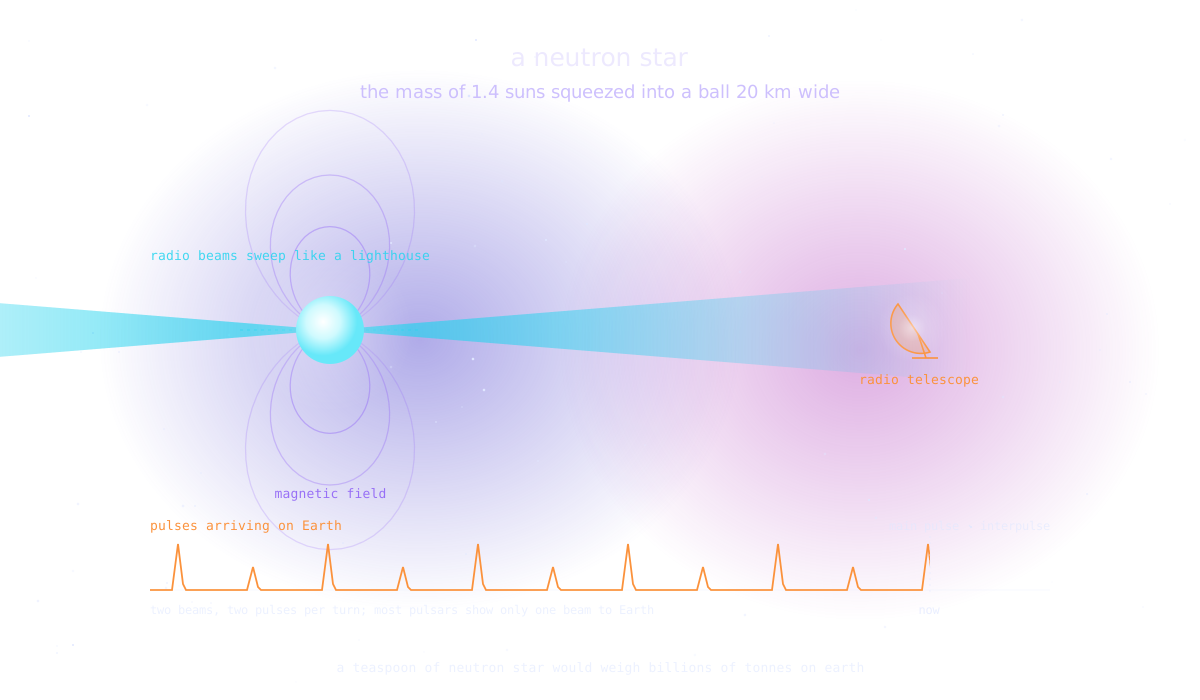
When a giant star collapses, its core can become a neutron star: as heavy as the Sun but the size of a city, spinning fast and sweeping radio beams across space, which we see on Earth as regular pulses.
SpaceTime
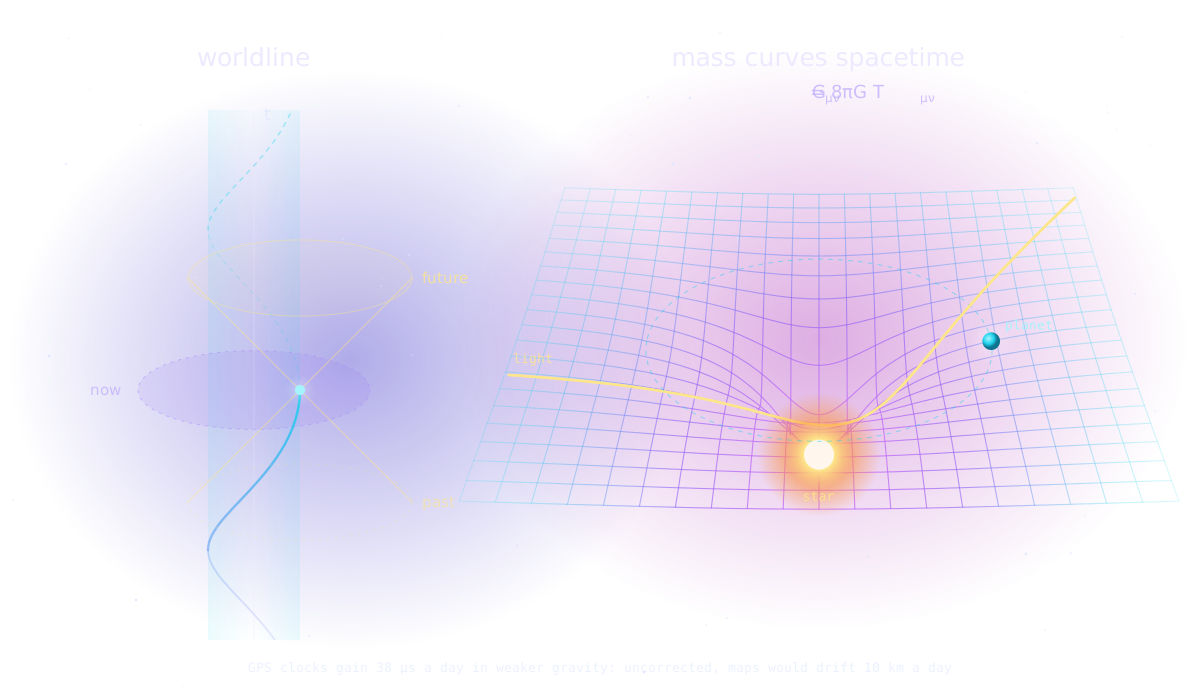
Mass curves spacetime: a planet orbits inside the well, light bends past the star and every object follows its worldline.
Universe
Zooming out from the Sun: the solar system sits inside the Oort cloud, among nearby stars, within the Milky Way, which belongs to the Local Group, part of the Laniakea supercluster, one thread of the cosmic web that fills the observable universe.